
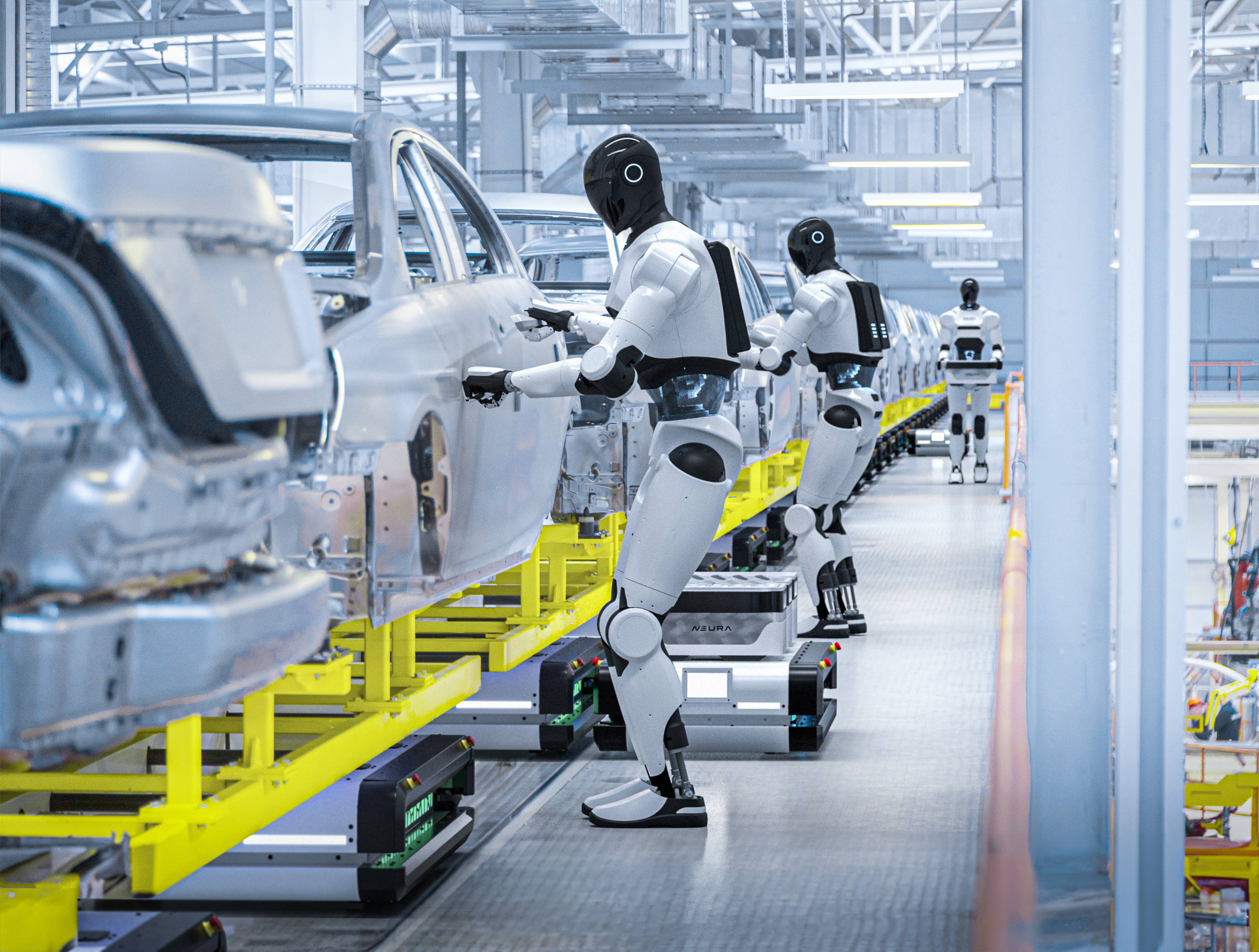
NEURA Robotics is in active discussions to raise up to $1.4 billion in Series C funding, a figure that would rank among the ten largest venture rounds ever closed by a robotics company. The Metzingen, Germany-based manufacturer of cognitive robots plans to deploy the capital primarily toward expanding global production facilities for humanoid platforms and scaling its MAiRA robot learning infrastructure, according to sources familiar with the financing. The round remains in flux and final figures could shift, but the target represents a dramatic escalation from NEURA's Series B, which closed at an undisclosed amount in early 2023. CEO David Reger founded the company in 2019 with a focus on cognitive robotics systems that integrate multimodal sensing, natural language processing, and force-sensitive manipulation in a single platform.
The fundraising timeline coincides with NEURA's preparations to enter volume production of its 4NE-1 humanoid robot, unveiled in prototype form at the company's annual technology showcase in Munich this past September. That system, standing 170 centimeters tall and weighing 68 kilograms, features six degrees of freedom per arm, torque-sensing joints throughout the kinematic chain, and onboard visual-language models for task planning. NEURA has positioned the 4NE-1 as a direct competitor to Figure AI's Figure 02 and Agility Robotics' Digit, with stated ambitions to begin pilot deployments in automotive and logistics environments by the third quarter of 2025. The company already manufactures the MAiRA series of collaborative robot arms at its Baden-Württemberg facility, shipping approximately 2,800 units since commercial availability began in late 2022. Those cobots occupy the premium segment of the market, with list prices ranging from €35,000 to €68,000 depending on payload and reach specifications. Industry observers note that humanoid production requires entirely different manufacturing processes, supply chain depth, and quality control regimes compared to traditional industrial robots.
NEURA's MAiRA robot learning platform represents the second major use of proceeds in the contemplated Series C. The software layer, announced in March 2024, provides a cloud-native environment for training manipulation policies using demonstration data, simulation, and reinforcement learning. The system currently supports PyTorch and TensorFlow models, interfaces with Isaac Sim and MuJoCo physics engines, and offers API integration with major computer vision foundation models including OpenAI's GPT-4V and Anthropic's Claude 3.5 Sonnet. Early access partners include Schaeffler Group, which is testing MAiRA-trained policies for bearing inspection tasks at its Schweinfurt plant, and DHL Supply Chain, running warehouse pick-and-place evaluations across three European distribution centers. NEURA claims the platform reduces time-to-deployment for new manipulation tasks from weeks to days in structured environments, though independent validation of those metrics remains limited. The company charges licensing fees on a per-robot basis with tiered pricing for cloud compute resources used during training and inference.
The robotics funding environment has tightened considerably since the sector's 2021 peak, when investors deployed $7.9 billion across 487 deals globally, per PitchBook data. Total 2024 investment dropped to approximately $4.2 billion through November, concentrated heavily in late-stage rounds for companies with demonstrated revenue traction or clear paths to production scale. Humanoid-focused startups have defied the broader pullback: Figure AI closed a $675 million Series B at a $2.6 billion valuation in February 2024, while 1X Technologies raised $100 million in a round led by EQT Ventures four months later. Strategic investors including BMW Group, Siemens, and Nvidia have entered the cap tables of multiple humanoid developers, signaling corporate recognition that the form factor may achieve technical and economic viability within a compressed timeline relative to earlier expectations. NEURA's ability to close at the $1.4 billion target will depend substantially on demonstrating credible production roadmaps, validated performance data from pilot deployments, and differentiated capabilities in the increasingly crowded humanoid landscape.
What to Watch: Track NEURA's announcement of lead investors and final close amount, expected before the end of Q1 2025. Monitor deployment announcements for the 4NE-1 humanoid in automotive or logistics settings, particularly any partnerships with German OEMs or their Tier 1 suppliers. Watch for MAiRA platform adoption metrics, specifically the number of production environments running NEURA-trained policies and any published data on task success rates or deployment timelines compared to traditional programming methods.