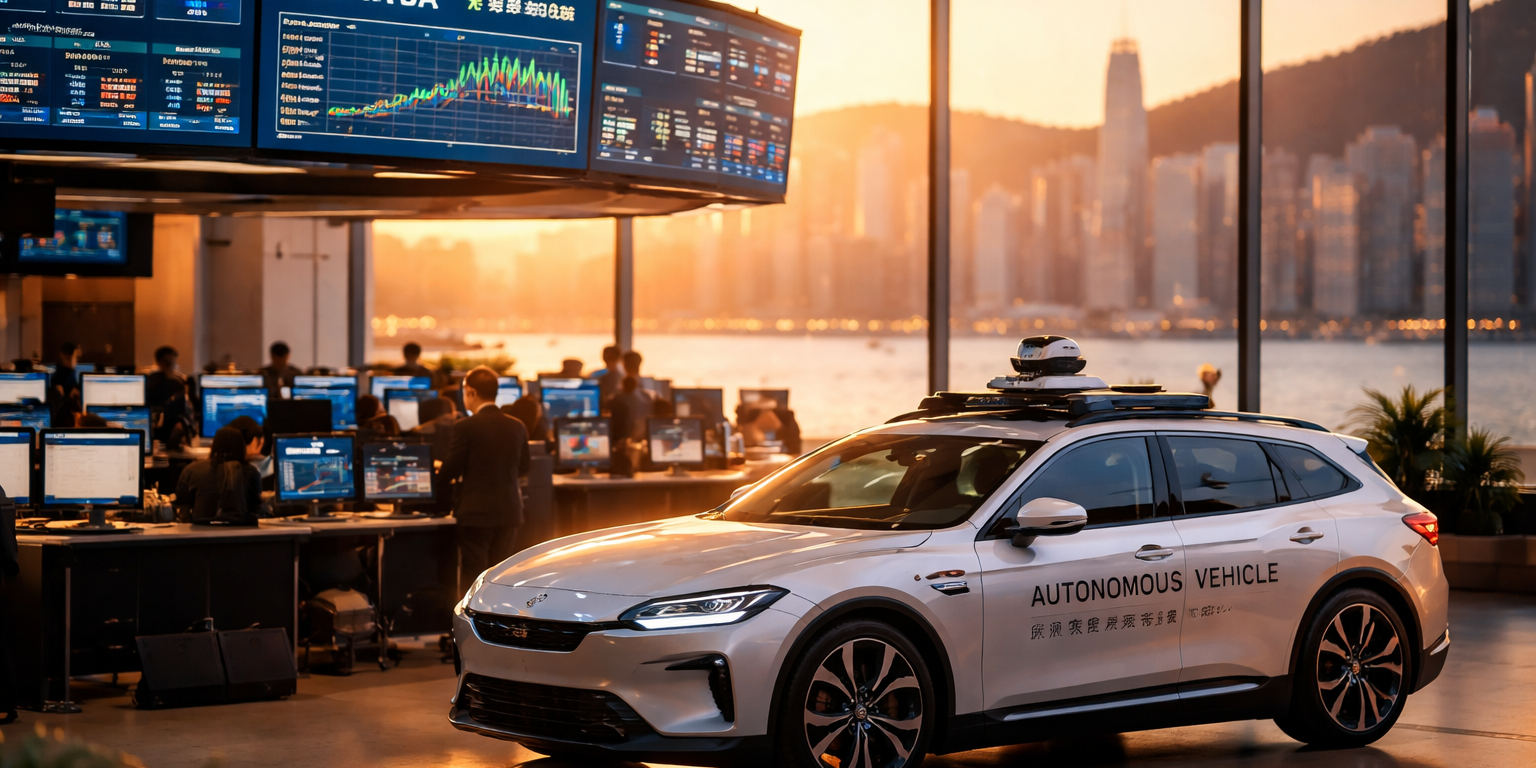
Momenta priced its Hong Kong initial public offering at HK$295.60 per Class A ordinary share on June 29, targeting gross proceeds of HK$5.89 billion before any over-allotment exercise. The Suzhou-based company secured commitments from three heavyweight institutional investors as cornerstones: Singapore's GIC Private Limited, Fidelity International, and BlackRock. Trading on the Hong Kong Stock Exchange's main board begins this week under ticker symbol 6880.HK, marking one of the autonomous driving sector's most significant public market entries since the recalibration that followed the 2024 regulatory scrutiny of AV technology in both China and the United States. The cornerstone allocation structure, while customary for Hong Kong listings, signals institutional confidence in Momenta's dual-platform strategy combining highway and urban autonomous driving systems at a moment when many Western competitors have narrowed their development focus to single use cases.
The company's pathway to public markets reflects a broader maturation within China's autonomous vehicle ecosystem. Momenta was founded in 2016 by Cao Xudong, a former Microsoft researcher, and has since developed partnerships spanning both passenger vehicle manufacturers and commercial fleet operators. The firm operates two parallel technology tracks: a highway autonomous driving solution already deployed in production vehicles from automakers including SAIC Motor and Toyota's joint venture partners in China, and an urban autonomous driving system currently undergoing expanded testing in multiple Chinese cities. Unlike pure-play robotaxi developers such as WeRide or AutoX, Momenta's business model centers on licensing perception and planning software to automotive manufacturers rather than operating its own vehicle fleets. This approach generates recurring revenue through per-vehicle licensing fees and over-the-air software updates, a model more closely resembling Mobileye's tier-one supplier relationships than Waymo's vertical integration strategy. The company reported partnerships with more than fifteen automakers as of the prospectus filing date, though specific revenue figures and unit deployment numbers remain subject to confidentiality agreements with manufacturing partners.
The cornerstone investor composition merits scrutiny. GIC's participation extends its substantial exposure to Chinese mobility technology, following earlier investments in Didi Global and autonomous truck developer TuSimple before that company's delisting troubles. Fidelity International and BlackRock, meanwhile, bring global asset management scale to a deal that explicitly targets international institutional capital beyond Hong Kong retail investors. The pricing at HK$295.60 per share implies a fully diluted valuation that the prospectus pegs in the mid-single-digit billions of U.S. dollars, though exact comparisons to private market valuations remain complicated by differences between the Class A shares offered publicly and the dual-class structure preserving founder control. The company's decision to list in Hong Kong rather than pursue a U.S. listing through NASDAQ or NYSE reflects both the tightened scrutiny Chinese technology companies face under American regulatory frameworks and Hong Kong's emergence as the default venue for Chinese AI and autonomous vehicle firms seeking public market liquidity. The city's exchange has courted technology listings aggressively since implementing reforms allowing dual-class share structures and pre-revenue biotech firms in 2018, though trading volumes for mainland Chinese companies in Hong Kong have proven volatile relative to their stateside peers.
Momenta's timing arrives as the autonomous driving investment landscape undergoes structural realignment. General Motors scaled back Cruise operations following the San Francisco pedestrian dragging incident in late 2024. Ford and Volkswagen dissolved their Argo AI joint venture in 2022. Apple abandoned its decade-long vehicle project earlier this year. Against that backdrop of consolidation and retreat among Western players, Chinese autonomous driving developers have accelerated real-world deployments, supported by municipal governments eager to establish local AV leadership and national policies treating intelligent vehicles as strategic infrastructure. Beijing, Shanghai, Shenzhen, and Guangzhou now permit fully driverless testing in designated zones without safety operators behind the wheel. Baidu's Apollo Go robotaxi service logged more than four million rides across multiple cities in 2025. Momenta's IPO proceeds, according to the prospectus, will fund expanded testing in additional Chinese cities, refinement of its generative AI-based perception systems that process multi-modal sensor inputs, and potential international expansion beginning with Southeast Asian markets where Chinese automaker partnerships provide natural entry points. The company employs approximately 1,200 engineers, with research centers in Suzhou, Beijing, and Stuttgart, Germany, the latter facility focused on partnerships with European automotive suppliers exploring Chinese autonomous driving technology licensing as a faster route to market than in-house development.
What to Watch: Monitor whether Momenta's share price on the secondary market holds above the IPO price through the first 30 days of trading, a key indicator of institutional demand beyond the cornerstone allocations. Track announcements from Chinese automakers regarding production vehicle launches incorporating Momenta's urban autonomous driving stack, expected in the second half of 2026. Watch for regulatory filings in Hong Kong regarding the size of any over-allotment exercise, which could add up to 15 percent to the base offering if underwriters exercise the greenshoe option fully. Pay attention to whether GIC or other cornerstone investors make additional purchases in the open market after their six-month lock-up periods expire.