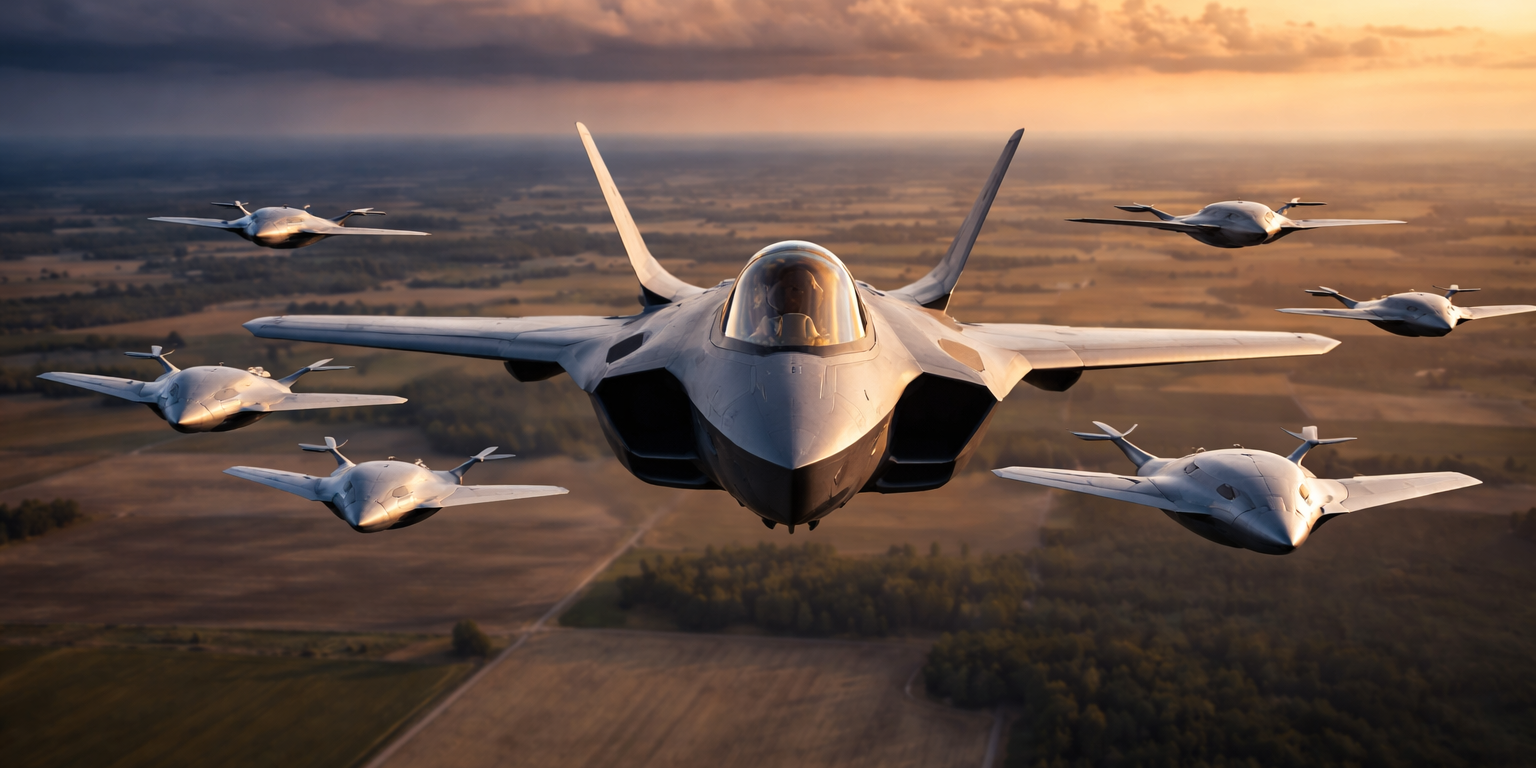
Military unmanned aerial vehicle spending will triple within five years, reaching $109.22 billion by 2031 from a baseline of $34.85 billion in 2026, according to a market analysis released this week by MarketsandMarkets. The 25.7% compound annual growth rate marks one of the fastest expansion periods in defense procurement history, outpacing growth in crewed aircraft, ground vehicles, and naval systems. The forecast represents a significant upward revision from earlier projections. A report issued by the same firm eighteen months ago had projected the military UAV market would reach just $22.81 billion by 2030 at a 7.6% growth rate, suggesting defense ministries worldwide have dramatically accelerated procurement timelines in response to operational lessons from recent conflicts.
The revision reflects real-world battlefield performance data that has reshaped procurement priorities across NATO, Indo-Pacific allies, and non-aligned states. Ukraine's extensive use of commercial and military drones against Russian forces demonstrated both the tactical effectiveness of low-cost expendable systems and the vulnerability of conventional armored formations to persistent aerial surveillance. Israel's operations in Gaza similarly showcased the operational value of coordinated drone swarms for urban reconnaissance and precision strike missions. These conflicts provided empirical validation for capabilities that existed primarily in concept demonstrations and controlled testing environments as recently as 2024. Defense planners now have kill chain data, cost-per-engagement metrics, and attrition rates that justify budget reallocations away from legacy platforms. The Pentagon's fiscal year 2027 budget request, submitted to Congress in April, included a 34% increase in unmanned systems procurement compared to the prior year, with specific line items for counter-UAS technologies, AI-enabled target recognition systems, and extended-range loitering munitions.
The growth trajectory splits unevenly across platform classes and mission profiles. Small tactical drones under 25 kilograms represent the fastest-growing segment, driven by demand for expendable reconnaissance and loitering munition systems that cost between $2,000 and $50,000 per unit. NATO members alone have issued contracts for more than 180,000 such systems since January 2025, according to procurement data compiled from defense ministry announcements. Medium-altitude long-endurance platforms like the MQ-9 Reaper and its international equivalents continue to see steady orders, particularly from Middle Eastern and Southeast Asian nations establishing or expanding persistent surveillance capabilities. Turkey's Bayraktar TB2 and China's Wing Loong II have captured significant export market share in this category, with both manufacturers reporting order backlogs extending into 2029. High-altitude long-endurance systems remain concentrated among a smaller group of operators, but development spending has intensified as the U.S., China, and European consortiums pursue next-generation platforms with 48-hour endurance, satellite communication redundancy, and beyond-line-of-sight control architectures.
Autonomy represents the central technical driver behind the market acceleration. Every major defense prime contractor now maintains dedicated AI teams focused on computer vision, collaborative mission planning, and autonomous decision-making within constrained rules of engagement. Northrop Grumman's MQ-4C Triton has logged more than 180,000 autonomous flight hours since 2024, with the aircraft executing pre-programmed maritime patrol routes, adjusting search patterns based on weather and sea state, and cueing human operators only for positive contact classification. General Atomics demonstrated cooperative behavior between four MQ-9s during exercises at Nellis Air Force Base in March, with the aircraft autonomously dividing search areas, sharing sensor tracks, and maintaining continuous coverage of a 400-square-kilometer box without ground control station input. These capabilities reduce operator workload and enable single crews to manage multiple aircraft simultaneously, a force multiplier that defense ministries find particularly attractive as recruitment challenges constrain personnel availability. The technology also enables mission profiles that would be impossible with human pilots, including extended loiter in contested electromagnetic environments where communication links degrade intermittently.
What to Watch: Lockheed Martin's Next-Generation Air Dominance uncrewed collaborative combat aircraft is scheduled for first flight in December 2026, which will demonstrate loyal wingman concepts at scale. The European Union's joint procurement mechanism for tactical drones faces a September 2026 deadline for member state commitments, potentially creating a unified specification that could reshape the commercial market. India's Defence Research and Development Organisation plans to deliver 200 Ghatak stealth UCAVs to the Indian Air Force by mid-2027, marking the first large-scale deployment of indigenous combat drones in the Indo-Pacific theater.