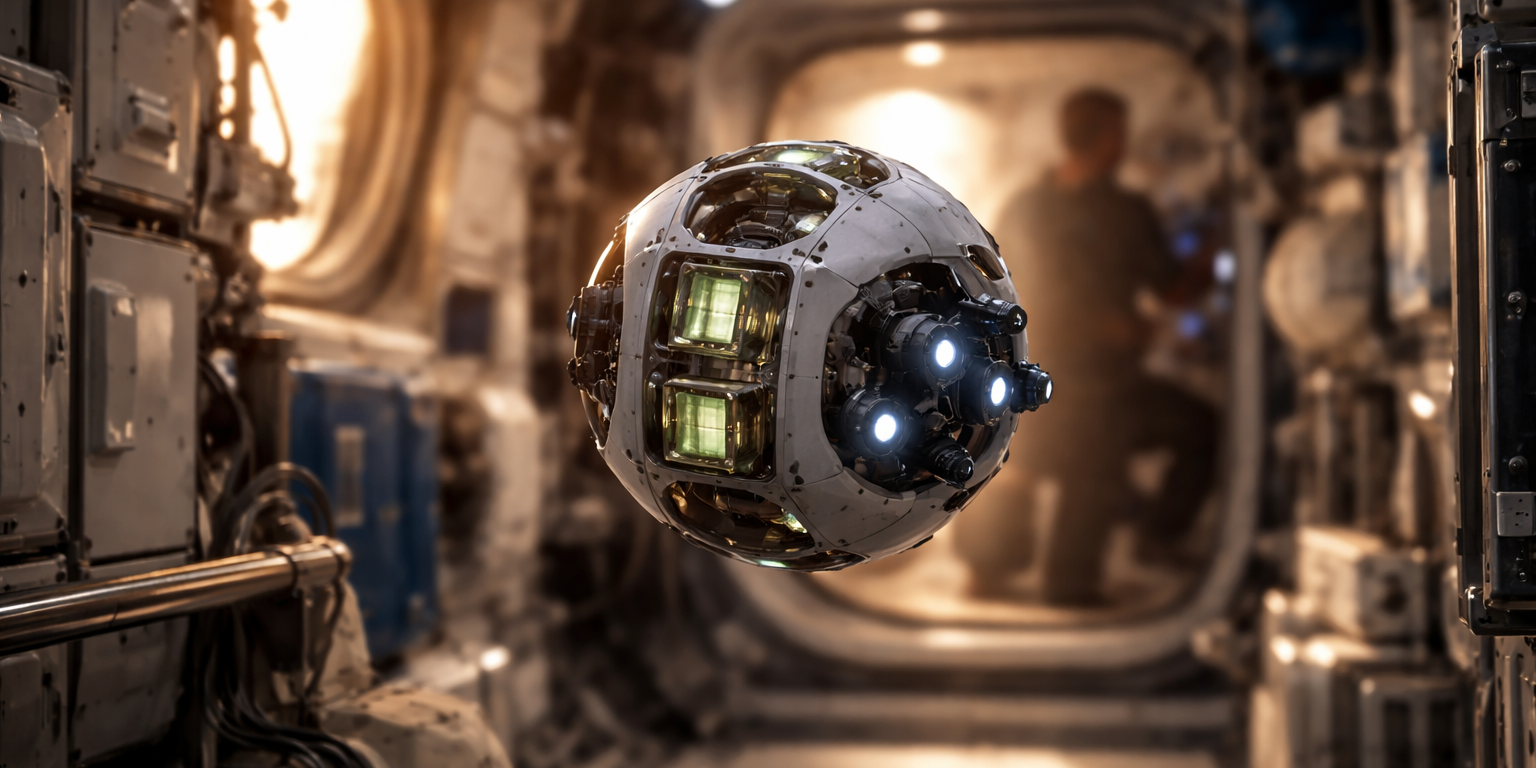
KULR Technology Group landed a contract to supply specialized battery systems for JOY, a free-flying robot that Icarus Robotics intends to deploy on the International Space Station. The KULR ONE Space battery will power JOY's onboard systems as the robot navigates the station's interior modules, performing tasks that currently consume astronaut time. Financial terms were not disclosed, but the agreement marks one of the first commercial applications of KULR's space-rated energy storage technology in an autonomous robotic platform rather than a static instrument package.
The technical challenge centers on thermal management in zero gravity. Batteries generate heat during discharge cycles, and without convective cooling, that heat must be conducted away through solid materials or radiated into space. KULR's design uses a carbon fiber structure with phase change materials embedded in the cell architecture, allowing the battery to absorb thermal spikes without active cooling fans or liquid loops. Energy density sits at roughly 220 watt-hours per kilogram, comparable to high-performance lithium-ion cells used in terrestrial drones, but with tighter tolerances for temperature variation and outgassing. The system passed NASA's JSC 20584 flammability test and meets ISS safety protocols for sealed electronics in pressurized modules.
Icarus Robotics based JOY's design on the legacy Astrobee platform, a cube-shaped robot developed by NASA's Ames Research Center that has operated on the ISS since 2019. JOY measures roughly 30 centimeters per side and propels itself using electric fans that push against the station's air. The robot carries cameras, sensors, and a small manipulator arm for interacting with equipment. Planned tasks include inventory management, air quality monitoring, and documenting hardware status with visual inspections. NASA's own Astrobee units have logged thousands of hours on similar work, proving that free-flyers can offload repetitive duties from the crew. Icarus aims to offer JOY as a commercial service, with NASA as an anchor customer and future opportunities on private space stations operated by Axiom Space and Northrop Grumman's planned facilities.
The ISS currently hosts multiple robotic systems, but most are fixed-position arms or externally mounted platforms. Free-flying interior robots remain relatively rare because they must navigate cluttered spaces, avoid collisions with crew and equipment, and operate autonomously for extended periods without ground intervention due to communication delays. Battery life directly limits mission duration. KULR's system is designed to support roughly four hours of continuous operation per charge, after which JOY returns to a docking station for power and data transfer. That runtime exceeds the two-to-three-hour endurance typical of earlier Astrobee missions, where thermal constraints forced shorter duty cycles. The improvement comes from KULR's passive thermal architecture, which eliminates the need to throttle power output to prevent overheating.
Beyond the ISS, demand for autonomous robots in orbit is accelerating as commercial space stations move from concept to construction. Axiom Space expects to attach its first module to the ISS in late 2027, with plans to detach and operate independently by 2030. Those facilities will require maintenance robotics from the outset, and private operators are more likely than NASA to procure off-the-shelf systems rather than developing custom hardware. Icarus is positioning JOY to fill that niche. The company also sees applications in lunar Gateway, the NASA-led station planned for lunar orbit, where communication delays with Earth make autonomous operation even more critical. KULR, meanwhile, is pursuing battery contracts for lunar surface robots, where temperature swings between minus 173 and 127 degrees Celsius demand robust thermal management. The company's technology originated in research for the Mars 2020 rover, where passive thermal control was essential for electronics survival during the Martian night.
What to Watch: Track Icarus Robotics for announcements on JOY's launch manifest, likely targeting a SpaceX cargo mission in the second half of 2027. Watch whether KULR secures additional contracts with Axiom Space or other commercial station developers as those programs mature. Monitor NASA's ISS technology demonstration calendar for JOY's first operational trials, which will validate performance metrics and inform requirements for future free-flying robots in orbital environments.