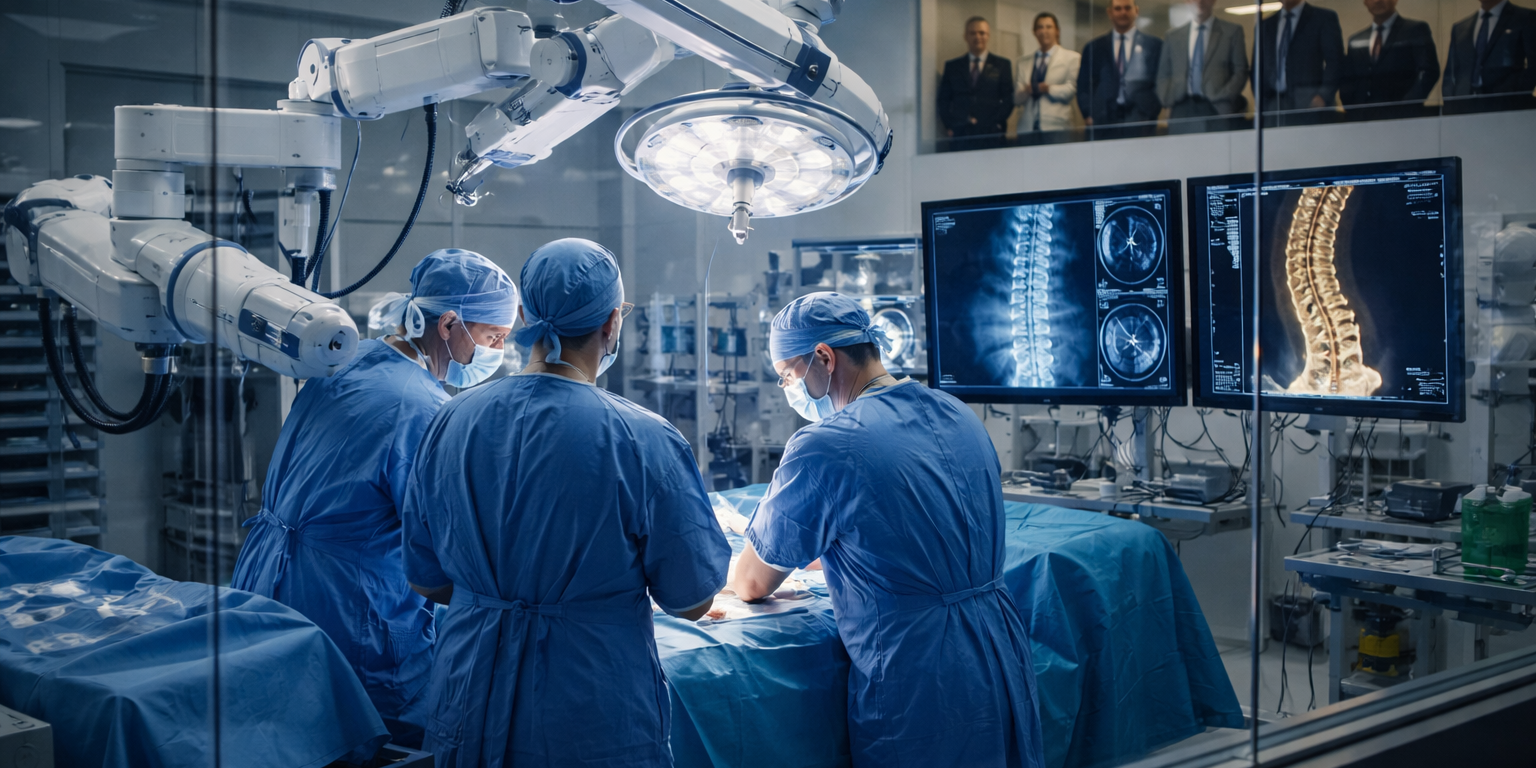

The Toumai system cleared EU regulatory requirements in mid-2026, granting MicroPort MedBot access to a market where Intuitive Surgical's da Vinci platform has commanded an estimated 80 percent share of robotic-assisted procedures since the early 2000s. The approval encompasses teleoperated neurosurgical applications, a segment where precision tolerances measure in tenths of millimeters and where vendor credibility has historically tilted toward established American and European manufacturers. MicroPort MedBot, a subsidiary of Shanghai-based MicroPort Scientific Corporation, has deployed more than 340 Toumai units across China since the platform's domestic launch in 2018, primarily in tertiary hospitals performing complex brain and spine procedures. EU market entry positions the company to compete directly with Medtronic, Zimmer Biomet, and Stryker in a region where reimbursement structures favor robotic-assisted surgery and where aging demographics drive demand for minimally invasive neurosurgical techniques. The regulatory clearance follows a clinical evaluation process that began in late 2024, involving data from over 12,000 procedures performed in Chinese facilities. European distributors have not yet been named, though industry observers expect MicroPort to prioritize Germany and France, where neurosurgical robot adoption rates exceed 22 percent among qualified centers. The approval does not extend to abdominal or thoracic applications, limiting initial market scope but allowing focused competition in a high-margin niche.
The concurrent AI benchmark achievement involves a clinical-grade large language model developed by an unnamed Chinese research consortium, which scored 89.7 on OpenAI's MedQA-USMLE assessment, surpassing GPT-4's previous high of 86.4. MedQA-USMLE tests medical reasoning across disciplines using retired United States Medical Licensing Examination questions, covering pharmacology, pathology, clinical decision-making, and diagnostic interpretation. The 3.3-point margin represents meaningful differentiation in a domain where model performance has plateaued near human expert levels since early 2025. OpenAI released the benchmark framework in 2023 as an open-access standard, enabling third-party validation of medical AI claims without proprietary testing environments. The Chinese model's architecture remains undisclosed, though performance metrics suggest training on multilingual medical corpora exceeding 200 billion tokens, likely incorporating Chinese-language clinical records unavailable to Western developers. Regulatory implications are immediate: European Medicines Agency guidelines issued in January 2026 permit AI clinical decision support tools that demonstrate benchmark superiority over existing FDA-cleared or CE-marked systems to enter accelerated review pathways, potentially shortening time-to-market from 18 months to under nine. No commercial entity has claimed ownership of the benchmark-topping model, fueling speculation that state-affiliated research institutes may license the technology to multiple vendors simultaneously, a strategy employed in China's semiconductor and renewable energy sectors.
MicroPort MedBot reported $340 million in revenue for fiscal 2025, with surgical robotics accounting for 62 percent of sales and orthopedic implants comprising the remainder. The company went public on the Shanghai Stock Exchange in 2021, raising $280 million at a valuation of $1.8 billion. Neurosurgical robotics represented MicroPort's entry point because the segment offered less entrenched competition than abdominal surgery, where Intuitive's da Vinci had accumulated over two decades of clinical data and surgeon training infrastructure. Toumai's teleoperation architecture differs from da Vinci's master-slave configuration by incorporating force feedback sensors that transmit tactile resistance to the surgeon console, a feature MicroPort engineers have described as critical for neurovascular procedures where excessive pressure can cause catastrophic hemorrhage. The system operates on a subscription pricing model uncommon in surgical robotics: hospitals pay $1.2 million upfront plus $48,000 annually for software updates, maintenance, and per-procedure instrument costs averaging $600. This contrasts with da Vinci's $2.5 million capital cost and $3,000 per-procedure instrument expense, though total cost-of-ownership analyses depend heavily on case volume and procedural mix. EU entry required MicroPort to establish European service infrastructure, a capital-intensive requirement that has deterred previous Chinese surgical robot developers from pursuing Western markets.
The developments arrive as regulatory agencies worldwide recalibrate approval frameworks for AI-augmented medical devices. The FDA published draft guidance in March 2026 permitting continuous learning algorithms in Class II surgical robots, provided manufacturers implement predetermined change control protocols and report performance drift exceeding defined thresholds. This regulatory shift favors platforms that integrate AI for preoperative planning, intraoperative guidance, and outcome prediction, capabilities that MicroPort has embedded in Toumai's software stack since the 2024 version release. European hospitals have shown greater willingness than American counterparts to adopt non-U.S. surgical robotics, partly due to procurement policies that reward competitive bidding and partly due to clinical evidence requirements that emphasize outcomes over brand legacy. A 2025 study published in The Lancet Digital Health found no statistically significant difference in complication rates between Toumai-assisted and da Vinci-assisted neurosurgical procedures when performed by surgeons with equivalent training hours, a finding that EU regulatory bodies cited in their approval rationale. The AI benchmark results amplify competitive pressure on Intuitive Surgical, Medtronic, and Johnson & Johnson, all of which have announced plans to integrate large language models into surgical planning workflows by late 2026 or early 2027. None have disclosed benchmark performance metrics.
What to Watch: Monitor European hospital procurement announcements in Germany and France through Q4 2026 for Toumai system orders, which will indicate whether competitive pricing can offset Intuitive Surgical's surgeon training network. Track whether the unnamed Chinese AI model receives CE marking as a standalone clinical decision support tool or gets licensed to surgical robot manufacturers for embedded applications. Observe FDA responses to MicroPort's anticipated U.S. market entry application, expected in Q1 2027, which will test whether reciprocal recognition of EU clearances accelerates American regulatory timelines. Watch for Intuitive Surgical's earnings calls in August and November 2026 for commentary on international competitive dynamics and pricing pressure in neurosurgical segments.