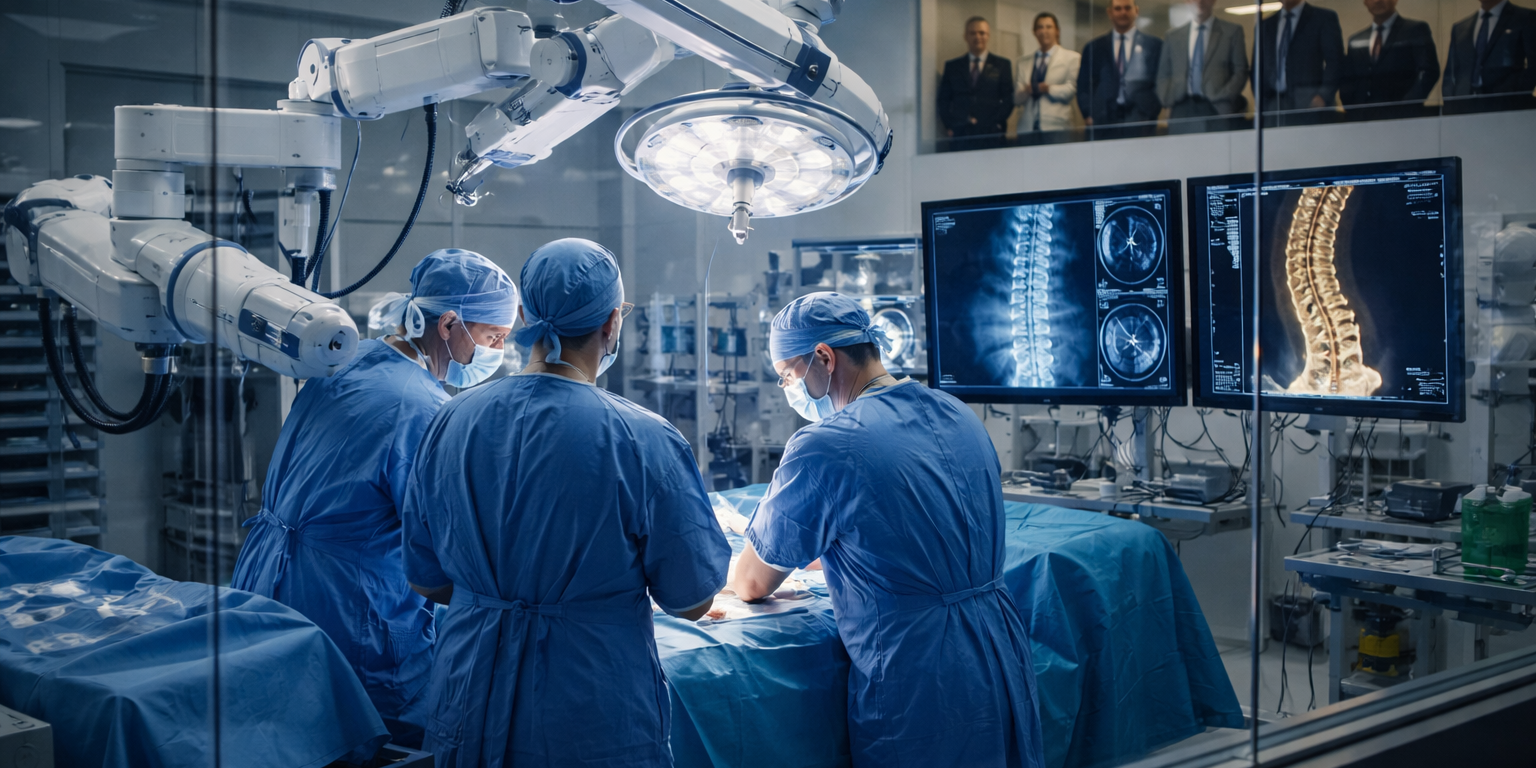
Jim Cramer told viewers during Mad Money's July 23 broadcast that Johnson & Johnson had finally proven its surgical robotics bet was paying off, a stark reversal from his commentary six months earlier when he questioned whether the New Brunswick conglomerate could ever catch Intuitive Surgical. The endorsement followed J&J's disclosure that its robotics division had crossed a threshold of procedural volume growth that institutional investors had been waiting to see. Cramer's commentary matters less for retail sentiment than for what it signals about shifting analyst frameworks. When a high-profile voice publicly reverses position on a company's technology strategy, it often reflects broader reassessment among institutional desks.
Johnson & Johnson entered the surgical robotics arena through its 2019 acquisition of Auris Health for $3.4 billion and the subsequent 2021 launch of its Ottava platform, designed to challenge Intuitive's da Vinci monopoly in robotic-assisted surgery. The company spent years absorbing criticism that it had entered too late and paid too much. Intuitive commanded roughly 80 percent of the installed base for robotic surgery systems as of early 2025, a dominance built over two decades and protected by network effects around surgeon training, hospital purchasing committees, and procedural reimbursement codes. J&J's challenge was never purely technical. The robotics market in surgery is less about hardware specifications than about clinical workflow integration, training infrastructure, and the trust surgeons place in systems during high-stakes procedures. Cramer's initial skepticism reflected conventional wisdom that those moats were impenetrable.
What changed between Cramer's criticism and his endorsement was evidence of traction in hospital systems outside Intuitive's traditional strongholds. J&J's strategy focused on modularity and interoperability, designing Ottava to integrate with existing operating room infrastructure rather than requiring dedicated suites. The company also targeted surgical specialties where Intuitive had lighter penetration, including thoracic and orthopedic procedures. By mid-2026, J&J's robotics segment was reporting procedure volume growth in the mid-twenties percentage range year-over-year, a pace that suggested the company was winning competitive evaluations at major hospital networks. Cramer cited unnamed sources at two large Midwest health systems who described Ottava as easier to deploy than competitive platforms. Whether that anecdotal feedback translates to durable market share gains remains the open question, but the narrative around J&J's robotics unit has shifted from skepticism about viability to debate about trajectory.
The broader implication for the robotics industry extends beyond surgical tools. Johnson & Johnson represents a class of incumbent industrials that spent the past decade acquiring robotics capabilities rather than building them organically. The success or failure of these bets will determine how the next wave of automation in regulated industries unfolds. If J&J proves that a well-capitalized latecomer can challenge an entrenched robotics monopoly through superior go-to-market execution, it validates the acquisition playbook that companies like Stryker, Medtronic, and Zimmer Biomet have pursued in parallel. If Intuitive maintains its dominance despite J&J's resources, it suggests that first-mover advantages in robotics are more durable than in software, with implications for how investors value emerging platforms in logistics, agriculture, and defense. Cramer's reversal captures this tension. His initial skepticism assumed robotics markets behave like tech markets, where scale and network effects compound quickly. His revised stance suggests he now sees surgical robotics as more like aviation or industrial automation, where operational reliability and customer intimacy matter as much as installed base.
The timing of Cramer's commentary also intersects with regulatory developments that could reshape competitive dynamics in robotic surgery. The FDA has been reviewing proposals to streamline approval pathways for software updates to autonomous surgical systems, a change that would allow faster iteration on machine learning models that assist with instrument positioning and tissue classification. J&J has publicly advocated for these regulatory reforms, arguing that the current framework treats software updates like new device submissions, slowing the pace of improvement. Intuitive, by contrast, has been more cautious in its public statements, a posture that some industry observers interpret as defensive. If the FDA moves forward with revised guidance in late 2026 or early 2027, as some expect, it could erode one of Intuitive's key advantages: the accumulated clinical data that supports its existing clearances. J&J and other challengers would gain the ability to deploy algorithmic improvements more rapidly, potentially closing the performance gap that has kept many hospitals loyal to da Vinci systems.
What to Watch: Monitor whether J&J discloses specific hospital network wins during its next earnings call, expected in October 2026, particularly any partnerships with academic medical centers that typically set standards for community hospitals. Track FDA docket comments on the proposed guidance for software updates to robotic surgical systems, with final guidance potentially arriving in Q1 2027. Watch for any strategic moves by Intuitive Surgical, including acquisition activity or partnerships that signal its response to J&J's growing traction in non-traditional specialties.