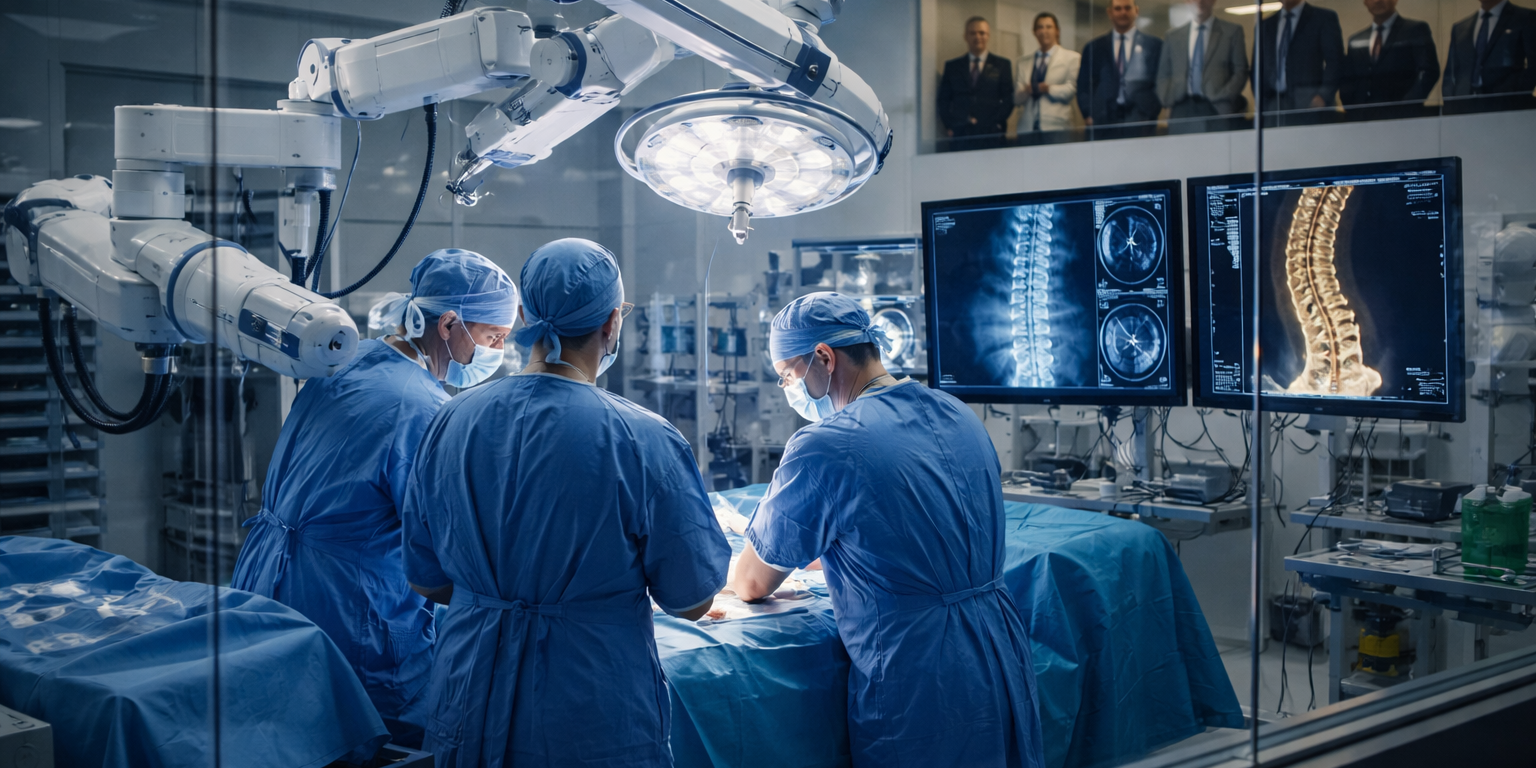

Sands Capital Global Growth Fund named Intuitive Surgical among its key holdings in its second quarter 2026 investor letter, pointing specifically to the company's deployment of artificial intelligence tools across its da Vinci robotic surgery platform. The investment firm, which manages assets for institutional and high-net-worth clients, described the AI enhancements as critical to addressing what it identified as the primary constraint on Intuitive's growth: the limited number of surgeons trained to operate da Vinci systems. The letter represents one of the first major institutional endorsements focused explicitly on Intuitive's AI roadmap rather than its traditional hardware sales metrics.
Intuitive has spent the past eighteen months embedding machine learning capabilities into multiple layers of its surgical ecosystem. The company's most visible AI effort, a computer vision system called da Vinci Insights, analyzes intraoperative video feeds to provide real-time guidance on instrument positioning and tissue identification. Surgeons at early adopter sites reported that the system reduced average procedure times for complex colorectal resections by eleven to fourteen percent, according to data Intuitive presented at the American College of Surgeons Clinical Congress in October 2025. But the broader play extends beyond procedure efficiency. Intuitive has also deployed AI-driven simulation modules within its training curriculum, allowing surgical residents to practice specific maneuvers in virtual environments that adapt difficulty based on performance. The company believes this accelerated training model could reduce the time required to achieve basic da Vinci proficiency from roughly forty procedures to fewer than thirty, a meaningful shift given that most residency programs allocate limited robotic surgery time to trainees.
The investor attention arrives as Intuitive faces intensifying competition from Medtronic, whose Hugo surgical robot has gained traction in Europe and secured FDA clearance for urology procedures in the United States earlier this year. Johnson & Johnson's Ottava platform, still in limited commercial release, represents another well-funded challenger designed with a smaller footprint and lower capital cost than da Vinci. Sands Capital's letter acknowledged these competitive dynamics but argued that Intuitive's data advantage—derived from more than fifteen million procedures performed on its installed base—creates a defensible moat for AI development. Each da Vinci procedure generates anonymized telemetry on instrument movements, tissue interactions, and surgeon decision patterns. That dataset, accumulated over two decades, gives Intuitive's machine learning models training material that competitors cannot easily replicate. The firm drew a parallel to Tesla's advantage in autonomous driving, where fleet data compounds the value of each incremental software improvement.
Intuitive reported 2,114 da Vinci system placements in 2025, a fourteen percent increase over the prior year, but procedure growth has outpaced hardware sales. The company logged 2.3 million procedures globally in 2025, up nineteen percent year-over-year, driven largely by increased utilization of existing systems. That divergence between system sales and procedure volume highlights the business model shift underway. Intuitive derives the majority of its revenue not from robot sales but from consumable instruments and service contracts tied to procedure volume. Each procedure requires roughly $2,000 in disposable instruments, and the company maintains service agreements on ninety-six percent of its installed base. AI tools that increase surgeon productivity or expand the range of procedures suitable for robotic assistance directly translate to higher-margin recurring revenue. Sands Capital's letter suggested this dynamic positions Intuitive more like a software-as-a-service business than a traditional medical device manufacturer, with gross margins approaching seventy percent on instruments and accessories.
What to Watch: Intuitive is expected to release updated AI feature sets for da Vinci 5, its newest platform, during the fourth quarter of 2026, with particular focus on autonomous suturing assistance and predictive analytics for complication risk. Monitor adoption rates for the machine learning-enhanced training modules at major academic medical centers, as broader rollout depends on validation from residency program directors. Track procedure volume growth in general surgery and thoracic specialties, where AI-driven guidance tools are seeing earliest deployment. Medtronic's response to Intuitive's AI positioning will likely emerge at the Medical Device Innovation Consortium conference in December 2026, where Hugo platform updates are rumored for announcement.