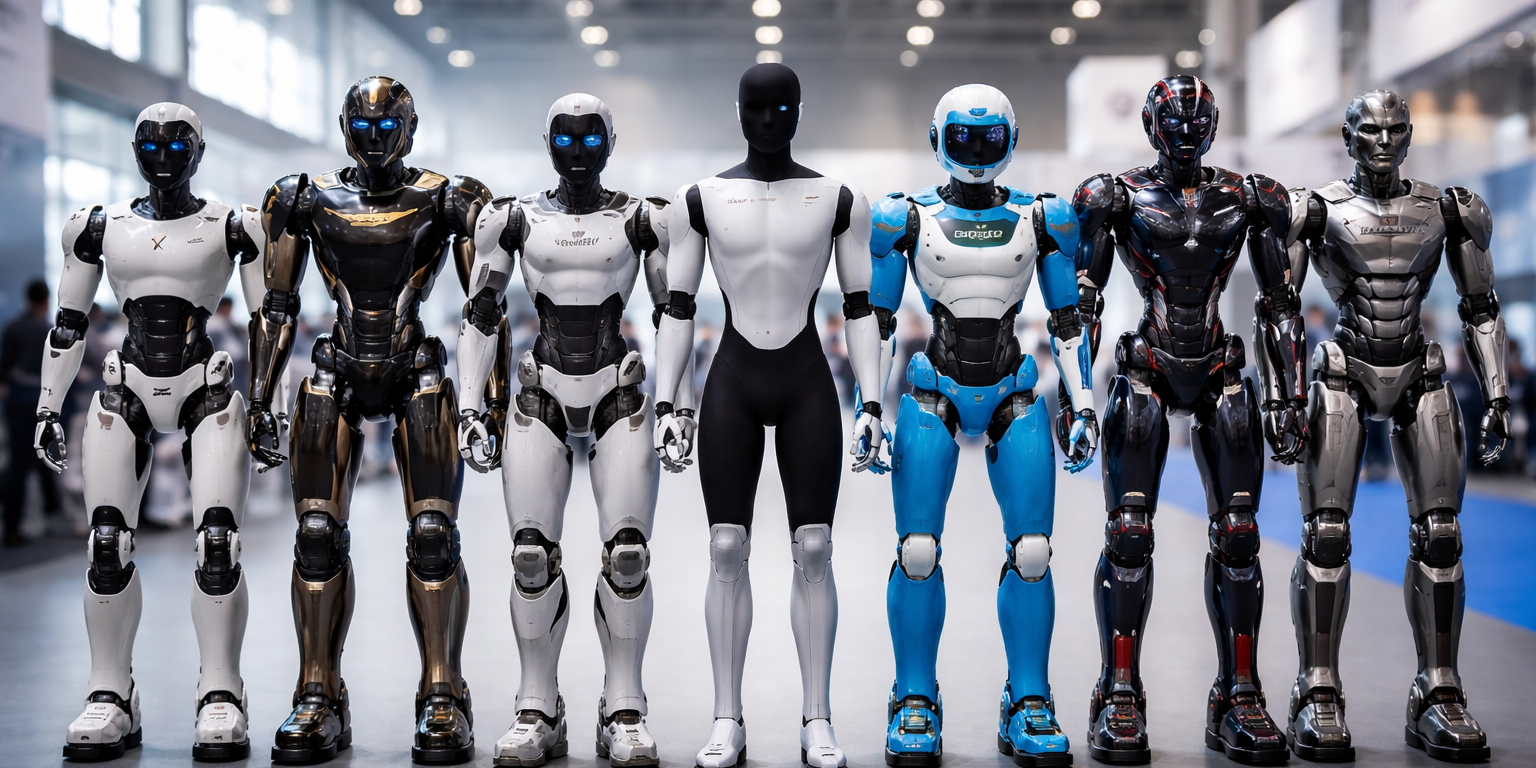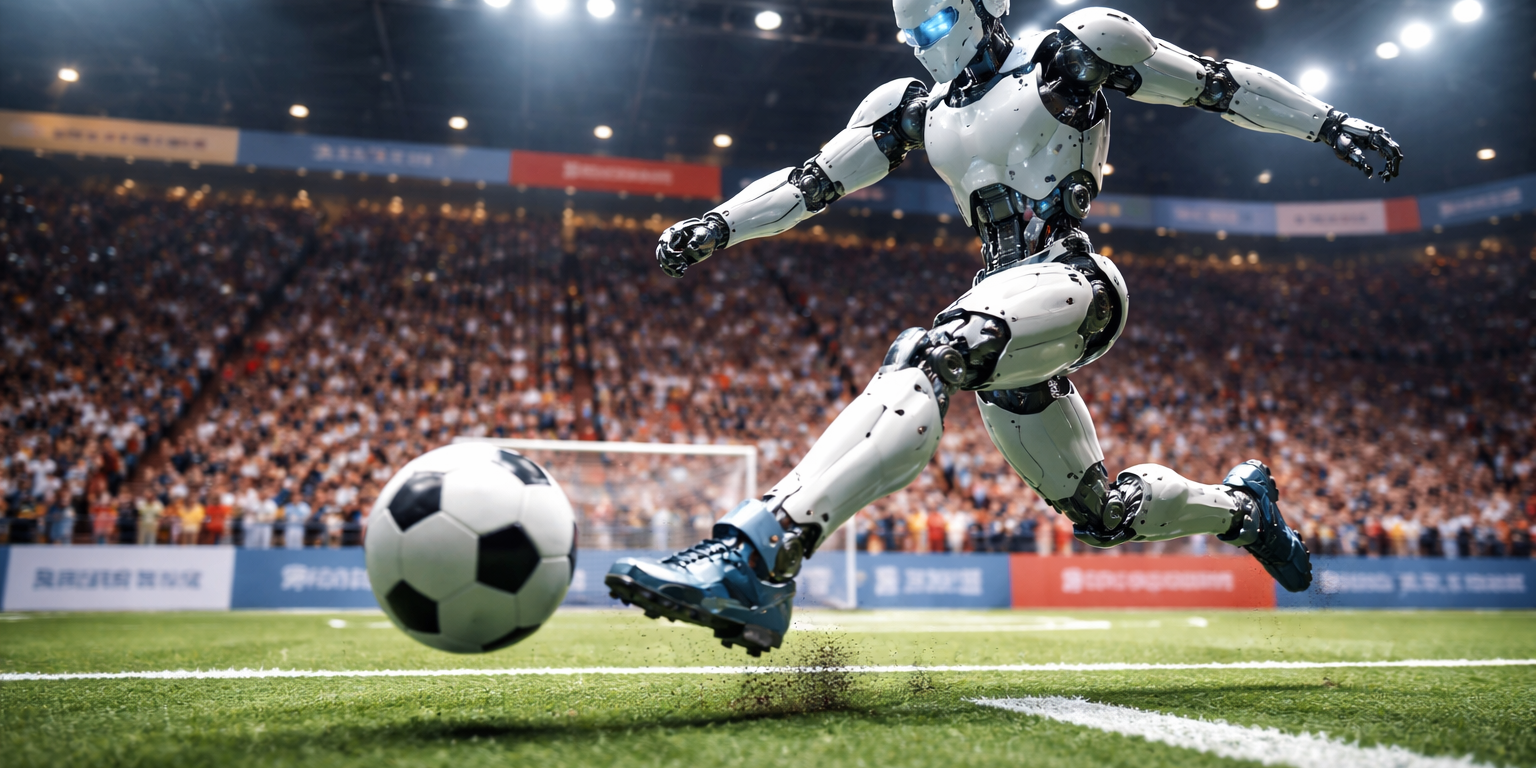
Nearly 100 penalty kicks separated eight Chinese robotics teams at MWC Shanghai 2026, where a fully autonomous humanoid robot shootout drew more than 10,000 spectators over two days. The competition, held at the Shanghai New International Expo Centre, outpaced attendance at traditional mobile industry attractions including smartphone unveilings and artificial intelligence keynotes. Each robot operated without remote control or human intervention, processing visual data, calculating ball trajectory, and executing kicks entirely through onboard systems. The format tested the full stack of embodied AI capabilities: computer vision under variable lighting, real-time motion planning, bipedal balance during dynamic movement, and mechanical precision under competitive pressure.
The event format represents a deliberate shift in how the robotics industry measures progress. Academic benchmarks and laboratory demonstrations have dominated embodied AI development for years, but controlled environments rarely expose the integration challenges that plague commercial deployment. Penalty kicks demand synchronized performance across perception, planning, and actuation systems within a three-second window. A robot must identify the ball and goal posts from multiple angles, account for its own positional uncertainty, generate a kick trajectory that compensates for joint compliance and ground friction, and maintain balance through a ballistic leg swing. Failure in any subsystem produces a visible, quantifiable result. The competition structure, with multiple rounds and head-to-head matchups, also introduces variability that static demonstrations avoid. Robots faced different lighting conditions between morning and afternoon sessions, varying distances as organizers adjusted ball placement, and the accumulated mechanical stress of repeated high-impact movements.
China's concentration of embodied AI expertise made the all-domestic field less surprising than it might have been three years ago. The country now produces more robotics PhD graduates annually than the United States and European Union combined, according to IEEE data, and government subsidies have funded at least forty humanoid robotics startups since 2024. Several teams competing at MWC Shanghai emerged from research labs at Tsinghua University, Shanghai Jiao Tong University, and the Chinese Academy of Sciences before spinning out commercial entities. Others originated as hardware divisions within larger technology conglomerates seeking vertical integration in robotics components. The penalty shootout provided these teams with international visibility at a fraction of the cost required for dedicated product launches. More critically, it offered benchmark data: completion rates, kick accuracy, cycle times, and failure modes that engineering teams can compare against internal performance metrics. Organizers recorded high-speed video of every attempt and have indicated they will release anonymized datasets to academic researchers, potentially establishing the competition as a standard evaluation framework.
The crowd response suggests embodied AI has crossed a threshold of public legibility that pure software systems have not. Spectators can immediately assess whether a robot succeeded or failed, unlike demonstrations of large language models or computer vision systems where outputs require technical interpretation. The physicality creates narrative tension absent from most enterprise technology showcases. When a robot stumbled during its approach or kicked wide of the goal, the reaction was visceral in ways that a chatbot producing an incorrect response never generates. This accessibility matters for an industry still seeking product-market fit beyond manufacturing and warehousing. Consumer robotics, eldercare assistance, and service applications all depend on building trust with non-technical audiences. A penalty shootout competition, while artificial, demonstrates competence in a universally understood task. It also exposes limitations transparently. Several robots required multiple attempts to stand after falls, and at least two withdrew after mechanical failures, according to attendees posting on Chinese social platforms. That vulnerability may paradoxically strengthen public perception by setting realistic expectations rather than overpromising capabilities.
The format's success at MWC Shanghai will likely inspire similar events as the humanoid robotics sector matures beyond laboratory prototypes and promotional videos. Physical competitions create urgency that accelerates development cycles and force teams to confront integration problems they might otherwise defer. They also generate media coverage and stakeholder interest more effectively than technical papers. Whether penalty shootouts become a recurring fixture or give way to more complex challenges—obstacle courses, object manipulation tasks, or human-robot collaboration scenarios—depends partly on how well they predict commercial viability. If teams that excel at penalties also achieve earlier commercial deployments, organizers will have validated the benchmark. If not, expect more sophisticated competitions that better capture the requirements of target applications.
What to Watch: Monitor whether MWC Barcelona 2027 adopts a similar humanoid competition format, potentially expanding participation beyond Chinese teams. Track publication of the anonymized performance dataset promised by Shanghai organizers, which could establish baseline metrics for bipedal dynamic movement. Watch for announcements from the participating teams regarding commercial partnerships or deployment pilots in the next 90 days, using competition performance as validation. Several Chinese robotics startups have historically timed funding announcements to follow high-profile demonstrations.