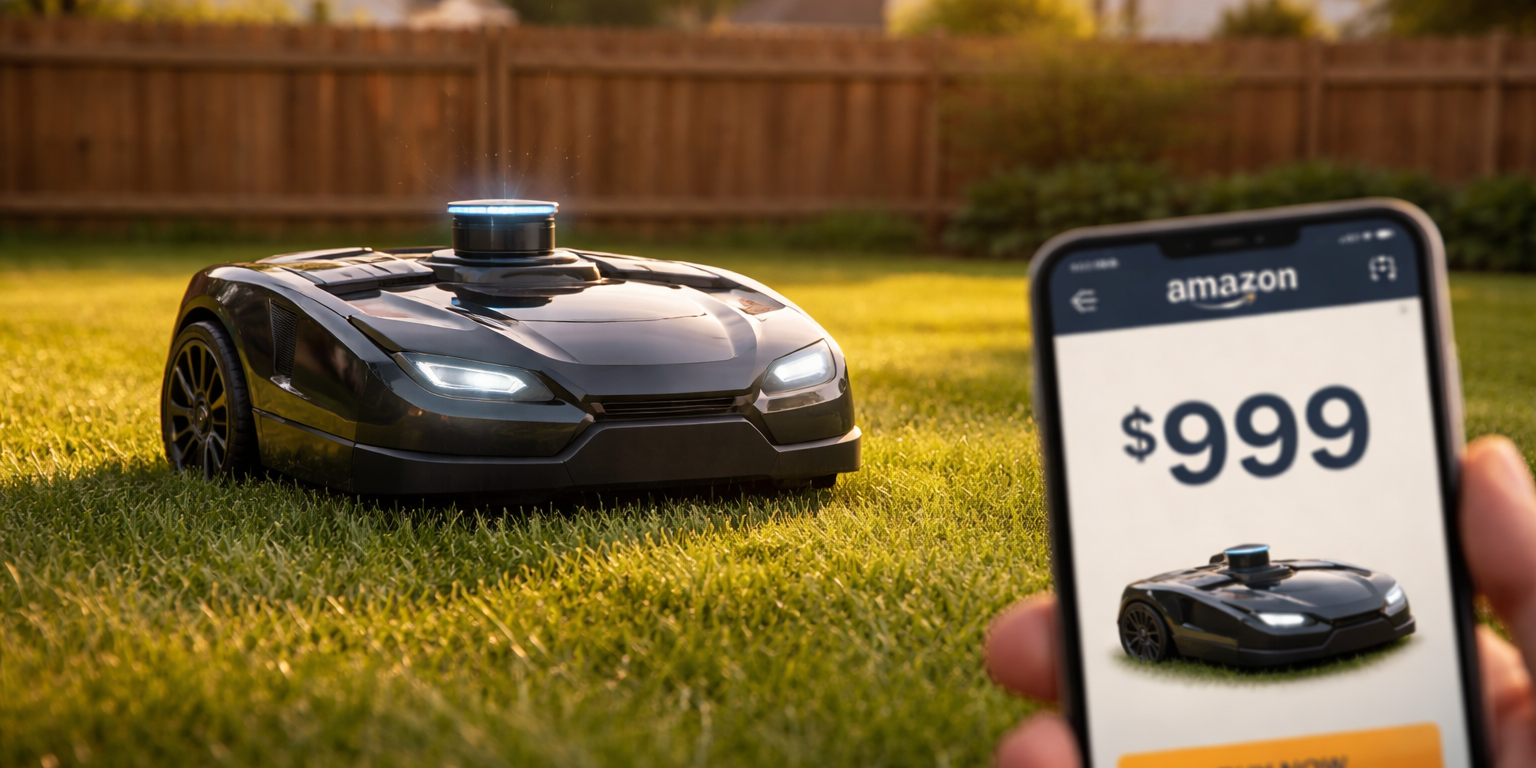
ECOVACS Robotics has dropped pricing on its Goat O1000 LiDAR PRO autonomous lawn mower to $999, matching the lowest price point the model has reached since its February 2026 debut at $1,500. The 33 percent discount, now live through Amazon's marketplace, positions the wire-free navigation system directly against Husqvarna's NERA 450X at $1,049 and Segway's Navimow i Series, which launched at $999 in April 2026. Industry observers note the timing coincides with seasonal purchasing patterns, but the sustained discount window suggests competitive pressure rather than promotional tactics.
The Goat O1000 represents ECOVACS's second attempt at the North American lawn care market after discontinuing its first-generation wire-guided model in late 2024. Engineers familiar with the platform point to its fusion of 2D LiDAR and visual odometry as the key differentiator, enabling simultaneous localization and mapping across properties up to 0.75 acres without perimeter wire installation. The system processes terrain data at 5 Hz and maintains positioning accuracy within 2 centimeters, specifications that put it between entry-level GPS models prone to signal drift and enterprise-grade SLAM platforms costing upward of $3,000. ECOVACS sources the LiDAR module from Shenzhen-based LSLiDAR Technology, the same supplier providing sensors to XAG agricultural drones and DeepRoute autonomous vehicles. The O1000's obstacle avoidance relies on a 150-degree field of view capable of detecting objects 10 meters out, processing decisions through an ARM Cortex-A53 quad-core processor running a proprietary Linux-based firmware stack.
Market dynamics explain the pricing pressure. Residential lawn care robotics reached $2.4 billion in global sales during 2025, according to ABI Research, with compound annual growth projected at 14 percent through 2029. Yet the sector remains fragmented across three distinct technology tiers. Wire-guided models from Worx and Landxcape dominate the sub-$500 segment with 48 percent market share but face mounting obsolescence as consumers reject installation complexity. Premium SLAM-equipped units from Mammotion and Luba command price points above $2,500, targeting early adopters willing to pay for cutting-edge autonomy. The middle tier where ECOVACS competes has become a proving ground for Chinese manufacturers entering Western markets through aggressive pricing. Segway Navimow shipped 127,000 units globally in 2025, leveraging parent company Ninebot's established distribution channels and undercutting European incumbents by 30 to 40 percent. ECOVACS sold an estimated 83,000 Goat units across all variants in the same period, respectable given the company's stronger brand recognition in vacuum robotics than outdoor power equipment. Executives at both companies face identical challenges: converting vacuum robot customers to lawn care platforms while building service networks capable of handling blade replacement, wheel repairs, and firmware updates across dispersed suburban installations.
The $999 price point matters because it sits just below the psychological $1,000 barrier that market research firm Parks Associates identifies as the threshold where mainstream homeowners consider autonomous mowers as replacements for traditional walk-behind equipment rather than novelty purchases. At this level, ECOVACS competes directly with premium cordless walk-behind mowers from Ego and Toro priced between $800 and $1,100, forcing a value proposition centered on labor savings rather than technological superiority. The company's challenge extends beyond hardware margins. Autonomous mower manufacturers generate recurring revenue through accessories, extended warranties, and in some cases, subscription software features. Husqvarna reports 23 percent of NERA buyers purchase its three-year service plan at $299. ECOVACS has yet to establish comparable attachment rates, a gap that becomes critical when hardware margins compress. Distribution represents another pressure point. ECOVACS sells primarily through Amazon and its direct-to-consumer website, avoiding the dealer networks that provide Husqvarna and John Deere with installation support and repeat service revenue. This model works for $400 vacuum robots where customers self-install, but autonomous mowers require property mapping, zone configuration, and seasonal maintenance that many homeowners outsource. Companies that crack this service model at scale will likely dominate the category by 2028, regardless of sensor technology advantages.
What to Watch: Monitor whether ECOVACS maintains the $999 price through September 2026, when seasonal demand typically peaks before winter inventory clearance. Track Husqvarna's response on the NERA 450X, which has held $1,049 since March despite market pressure. Watch for Mammotion's expected entry into the sub-$1,200 segment with its Luba 2 AWD variant, rumored for August 2026 launch with four-wheel-drive traction targeting hillside properties. Finally, observe attachment rates for extended warranties and blade subscription programs, the true indicator of which manufacturers are building sustainable business models versus buying market share.