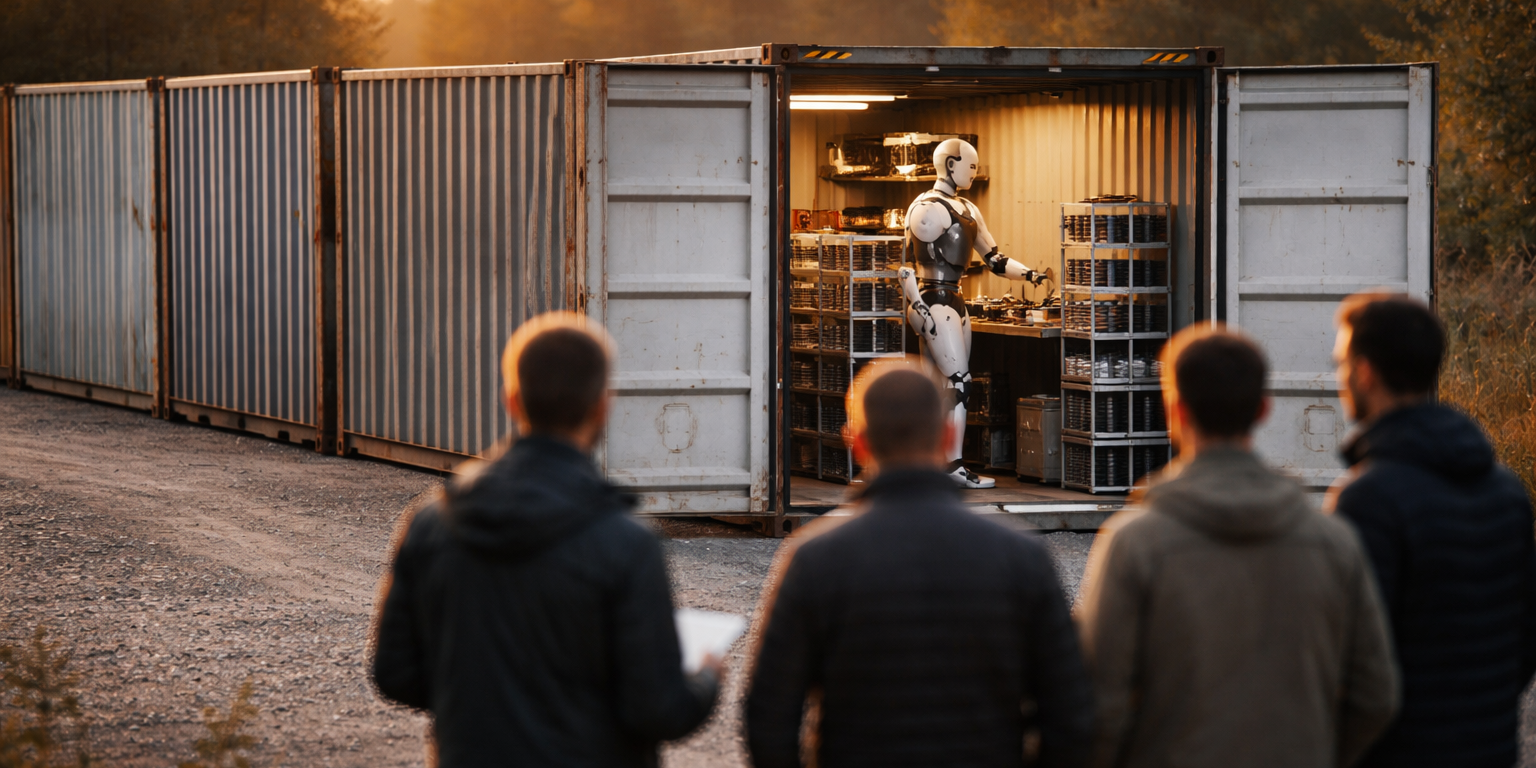
Twenty-two angel investors have collectively put €576,000 behind a Swedish startup that wants to run entire factories out of three shipping containers. The company, 120ft Factory AB, launched with that funding on October 16, 2026, and its pitch is narrower than most humanoid ventures: it does not plan to sell robots. It plans to build and operate compact production cells where humanoid machines do the work, then charge for what comes out the other end. The name is a literal footprint. Three 40-foot containers, laid end to end, add up to 120 feet. Everything the company intends to make has to fit inside that envelope.
The round is small. For perspective, a single humanoid prototype from a well-funded American or Chinese developer can cost more than the entire check, and the sector's headline raises now run into the hundreds of millions of dollars. That gap is the most telling detail in the story. A €576,000 budget does not buy a bespoke humanoid program, a custom actuator supply chain, or a proprietary foundation model. It buys integration. Almost certainly, 120ft is betting that commercially available humanoid platforms, which have multiplied across Europe, the United States, and China over the past two years, are now capable enough to be assembled into a working production line by a very small team.
That bet reflects a real shift in how the industry thinks about where value accrues. For years the assumption was that the winner would be whoever built the best robot. A growing contingent of engineers and investors now argues the opposite: hardware is commoditizing faster than expected, and the durable margin sits with whoever figures out the workcell, the process design, the safety case, and the uptime. Operators who own the whole loop capture the spread between robot cost and the value of finished goods. Operators who merely sell machines compete on price against manufacturers with far deeper pockets. 120ft is positioning itself squarely on the operator side of that divide.
The containerized format carries its own logic, and it is where a skeptical engineer will push hardest. Shipping containers are a known quantity for logistics, permitting, and relocation, which means a microfactory can in theory be trucked to wherever demand or cheap power exists. They also impose brutal constraints. Humanoids built for human-scale workspaces have to share tight aisles with fixtures, conveyors, and material staging. Thermal load, ventilation, and fire suppression all get harder in a sealed steel box packed with batteries and compute. Throughput per square meter is the number that matters, and nothing disclosed so far lets outsiders check it. The company has not said which robots it will use, what it will manufacture first, or what a unit costs to deploy.
Those omissions are standard for a pre-revenue startup, but they define the diligence questions that follow. Humanoid reliability remains the central unknown: mean time between failures, battery swap cadence, and the rate at which a robot can recover from an unexpected part orientation without a human stepping in. A factory that depends on bipedal machines inherits every one of those weaknesses and adds a few of its own, since a line only runs as fast as its slowest, least dependable station. If 120ft can show sustained hours of unattended production, even on a simple product, it will have demonstrated something many larger players still describe only in demos. If it cannot, the container becomes a very expensive display case.
The broader read for the industry is that capital is fragmenting. Mega-rounds for platform builders continue, but a parallel layer of small, specialized operators is emerging beneath them, funded by angels who want exposure to humanoid labor without underwriting a hardware company. That layer matters because it is where real-world performance data will accumulate. A microfactory running three shifts generates failure logs, cycle times, and cost-per-unit figures that no lab benchmark can replicate. Platform vendors will want that data, and operators like 120ft may end up as unofficial testbeds, trading early access and feedback for favorable hardware terms.
What to Watch
The first signal is disclosure: whether 120ft names its humanoid supplier and its first product in the next 30 to 60 days, since that choice reveals how much integration risk the team is really absorbing. Track whether a pilot container goes operational before the end of 2026, and whether the company publishes any throughput or uptime figures from it. Watch for a follow-on seed round in early 2027, which would indicate the angel syndicate saw production evidence worth doubling down on. Finally, keep an eye on larger humanoid makers announcing operator or factory-as-a-service partnerships, because that would confirm 120ft's model is being validated, or competed away, by the platforms it depends on.