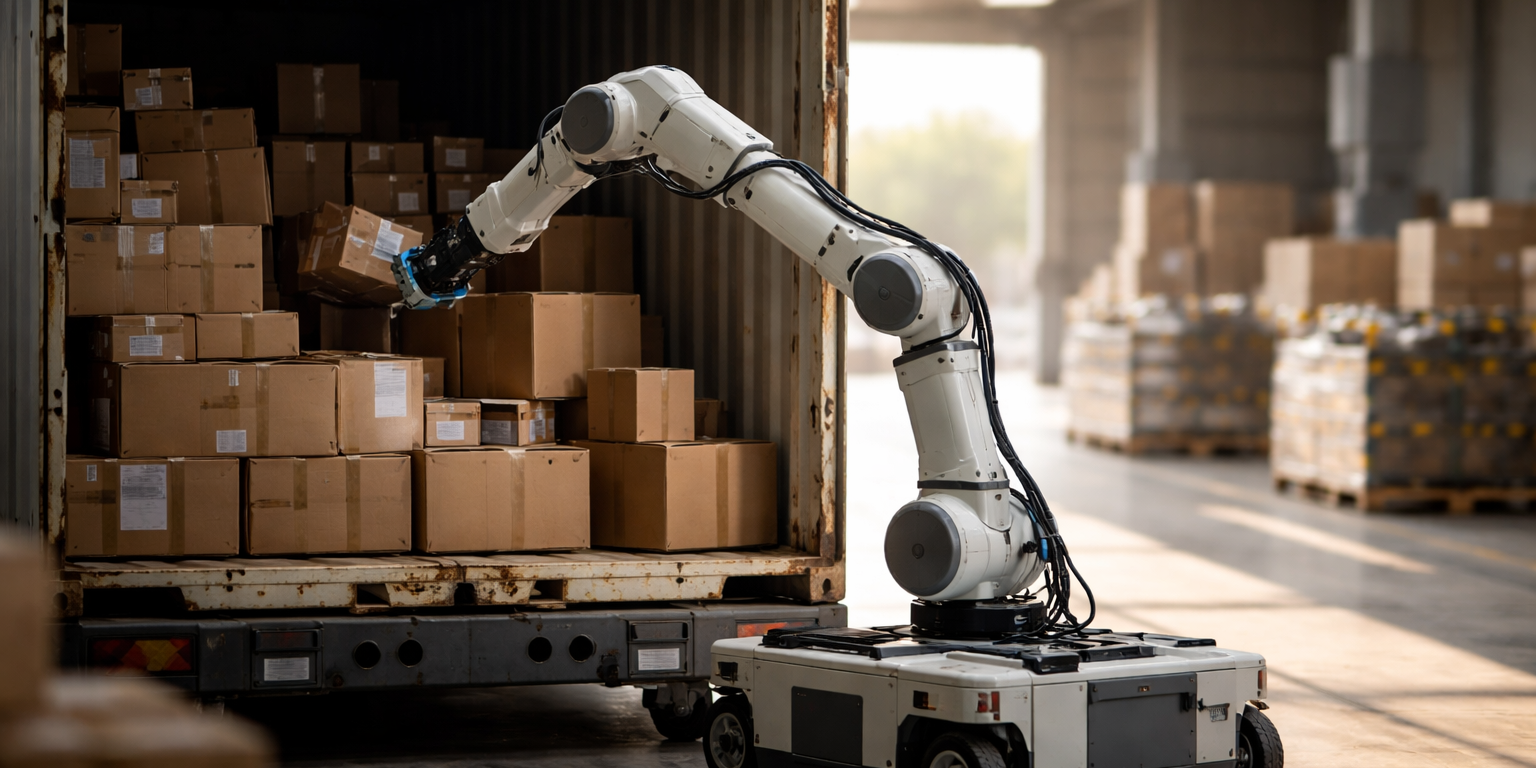
BAUHAUS operates 150 retail locations across Germany and needed a solution that could handle the physical chaos of mixed-SKU container unloading without requiring fixed infrastructure. XYZ Robotics delivered Rocky, a mobile manipulation platform that combines a six-axis arm, computer vision, and an autonomous mobile base to pull products from shipping containers, sort them by destination, and build stable pallets for warehouse storage. The system went live at the company's Krefeld distribution center in late June 2026, processing an average of 22 containers per day with no dedicated human labor on the receiving dock.
XYZ Robotics, headquartered in Boston with engineering operations in Shenzhen, has been refining mobile manipulation since its founding in 2018. The company raised a $33 million Series B in 2022 and has since focused on deployments in third-party logistics and retail distribution, where labor shortages and SKU complexity make fixed automation impractical. Rocky represents the third generation of the platform, now capable of identifying and handling over 95 percent of consumer goods packaging without pre-programmed object models. The robot relies on real-time depth sensing and tactile feedback to adjust grip force and orientation as it moves items from container to conveyor to pallet. BAUHAUS tested the system in a pilot program for four months before committing to the full installation, during which Rocky processed approximately 180,000 individual items with a damage rate below 0.3 percent.
The Krefeld deployment involves four Rocky units operating in parallel across two receiving bays. Each robot can unload a 40-foot container in roughly 90 minutes, compared to the four-hour average for a two-person human crew. XYZ Robotics did not disclose the contract value, but industry sources estimate a four-unit mobile manipulation system with integration and software licensing costs between $1.2 million and $1.8 million depending on customization requirements. BAUHAUS expects payback within 18 months based on labor savings and productivity gains, according to a statement from the company's logistics director. The retailer also noted that the system allows it to extend receiving operations into overnight shifts without adding headcount, effectively doubling throughput capacity during peak seasons. XYZ Robotics provided on-site training for BAUHAUS facility managers and remote monitoring support through a cloud-based fleet management dashboard that tracks uptime, error rates, and maintenance intervals.
Mobile manipulation remains one of the most technically demanding applications in warehouse automation. Unlike fixed robotic arms that operate in controlled environments with known object positions, Rocky must navigate dynamic spaces, handle products it has never encountered, and recover from edge cases like damaged packaging or unstable stacks. The system uses a combination of LiDAR, RGB-D cameras, and force-torque sensors to build a real-time understanding of its surroundings and adjust its motion planning on the fly. XYZ Robotics claims Rocky can handle items ranging from small boxes weighing less than a kilogram to irregularly shaped products up to 25 kilograms without reconfiguration. The BAUHAUS deployment is significant because it demonstrates the technology's readiness for high-mix, high-variability environments typical of retail supply chains. Other mobile manipulation vendors, including Dexterity and Pickle Robot, have focused primarily on parcel sortation and e-commerce fulfillment, leaving the home improvement and building materials sector largely unaddressed until now. BAUHAUS's willingness to deploy the technology at scale suggests confidence in both the hardware reliability and the return on investment, which could accelerate adoption among similar retailers across Europe.
What to Watch: Monitor whether BAUHAUS expands Rocky deployments to additional distribution centers before the end of 2026, particularly its larger facilities in Hamburg and Munich. XYZ Robotics is expected to announce at least two more European retail customers by Q4 2026, based on comments from CEO Larry Cheng at LogiMAT in May. Also track whether competing home improvement chains like Hornbach or OBI respond with their own automation initiatives, which would signal broader acceptance of mobile manipulation in the sector.