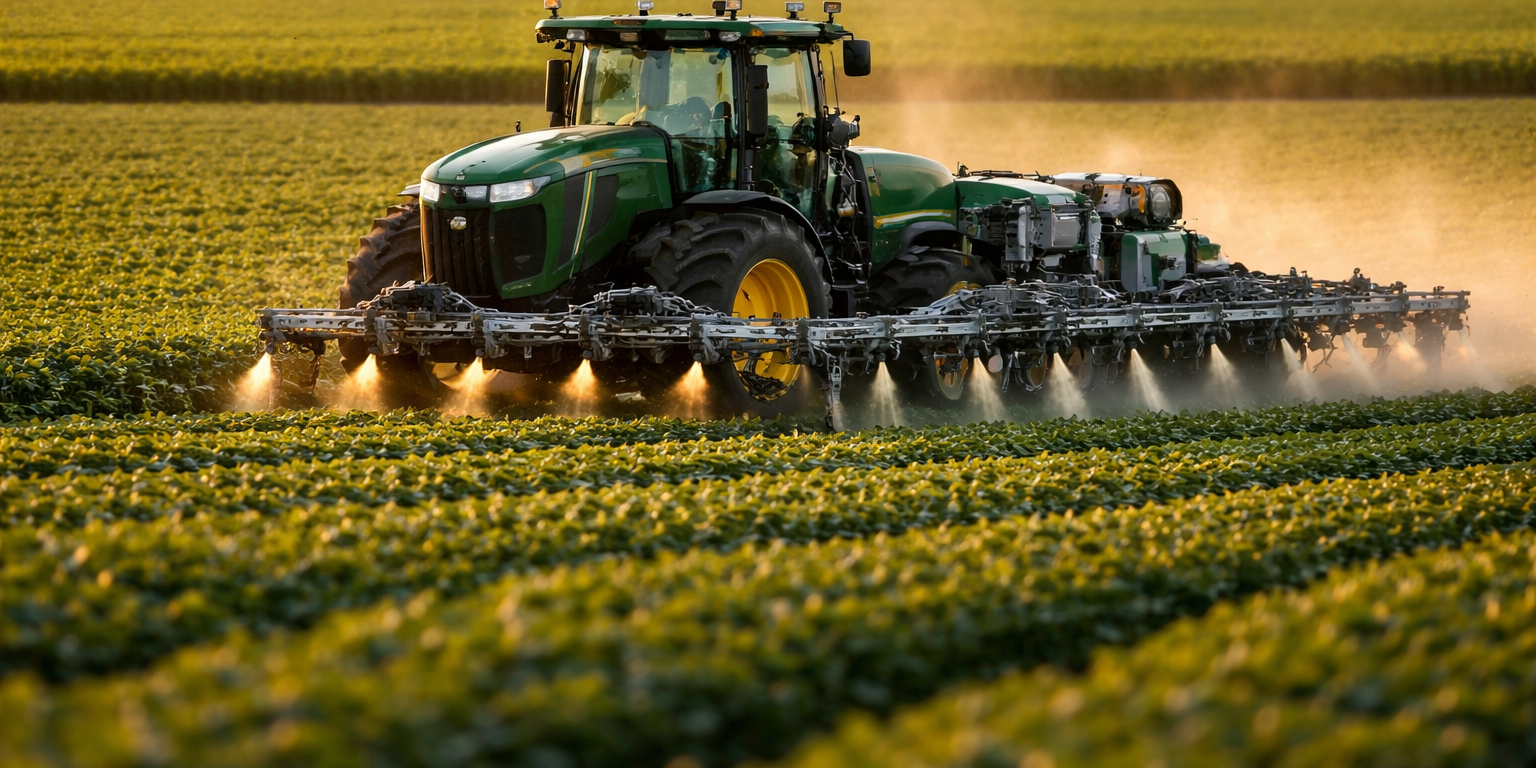
A self-driving John Deere tractor now pulls a robotic implement that applies fertilizer and herbicide to individual plants without a single operator present, marking the first time two separate U.S. agricultural robotics companies have integrated their core technologies into a single autonomous system. Sabanto Inc., based in Chicago, and Verdant Robotics, headquartered in Hayward, California, announced the integration after completing field trials that spanned multiple crop cycles across Illinois, Iowa, and Nebraska. The combined system handles route planning, obstacle avoidance, implement control, and chemical application entirely through software handshakes between the two platforms. Craig Rupp, founder and CEO of Sabanto, confirmed that the integration required no custom hardware modifications to either company's existing commercial products. Both systems communicate through standardized agricultural data protocols, allowing Sabanto's autonomy stack to feed real-time position and speed data to Verdant's application controllers while receiving feedback on nozzle performance and chemical flow rates.
Sabanto has operated autonomous tractors commercially since 2019, initially focusing on tillage and planting operations where precision down to the row level was sufficient. The company retrofits conventional tractors with sensor arrays, compute modules, and control actuators that replace human decision-making for field navigation. Verdant, founded by veterans of the Google robotics division and originally known as Carbon Robotics until a 2024 rebrand, developed a towed implement carrying multiple robotic arms equipped with computer vision systems. Each arm can identify individual plants, classify them as crop or weed, and deliver targeted doses of inputs measured in milliliters rather than gallons per acre. The Verdant system processes imagery from twelve cameras at 50 frames per second, running inference models trained on more than 40 million labeled plant images. Gabe Sibley, Verdant's co-founder and vice president of robotics, said the integration with Sabanto solved a persistent adoption barrier: farmers willing to invest in precision application technology still hesitated to dedicate an operator to monitoring the tractor during 12-hour field days.
The technical challenge centered on synchronization latency. Verdant's application system requires position accuracy within two centimeters to avoid spraying adjacent crops, but agricultural GPS systems typically update at 10 Hz while the robotic arms operate at 60 Hz. Sabanto's autonomy software now broadcasts predictive position data that accounts for tractor momentum and wheel slip, allowing Verdant's controllers to compensate for the time lag between when a plant is identified and when the nozzle reaches the target coordinates. The companies disclosed that their combined system achieved 94 percent application accuracy during corn season trials, meaning fewer than six plants per hundred received incorrect treatment. Industry standard for human-operated precision sprayers hovers around 78 percent, according to data from the American Society of Agricultural and Biological Engineers. The integrated platform also reduced chemical usage by 87 percent compared to broadcast application methods, a metric that matters in regulatory environments where herbicide-resistant weed populations are forcing farmers toward biological controls and mechanical removal.
Beyond the technical specifications, the partnership reflects a broader shift in how agricultural robotics companies approach market entry. Both Sabanto and Verdant raised venture capital during the 2019-2021 agtech boom, then faced investor pressure to demonstrate revenue traction as funding conditions tightened. Rather than compete for the same early adopter customers, the companies identified complementary capabilities that neither could develop internally within acceptable time frames. Sabanto operates a fleet services model where it owns the tractors and charges per-acre rates for autonomous field work, while Verdant sells its implements outright to large-scale producers and contract applicators. The integration allows Sabanto to offer higher-value services that command premium pricing, while Verdant gains access to customers who lack the labor to operate purchased equipment. Three major vegetable growers in California's Central Valley have already contracted for integrated services beginning in the 2027 season, according to sources familiar with the agreements. Equipment dealerships are also monitoring the partnership closely, as it demonstrates a pathway for selling advanced implements without requiring customers to manage the autonomy stack themselves.
What to Watch: Sabanto plans to expand its autonomous fleet by 40 units before the 2027 planting season, with all new tractors configured to support the Verdant integration. Verdant is developing a second implement variant designed for vegetable crops with narrower row spacing, expected to ship in Q1 2027. Major equipment manufacturers including AGCO and CNH Industrial have invested in both companies and may incorporate the integration protocols into their own precision agriculture platforms by late 2027. Track adoption rates among organic producers, who face stricter limitations on chemical inputs and may find the precision application economics particularly compelling.