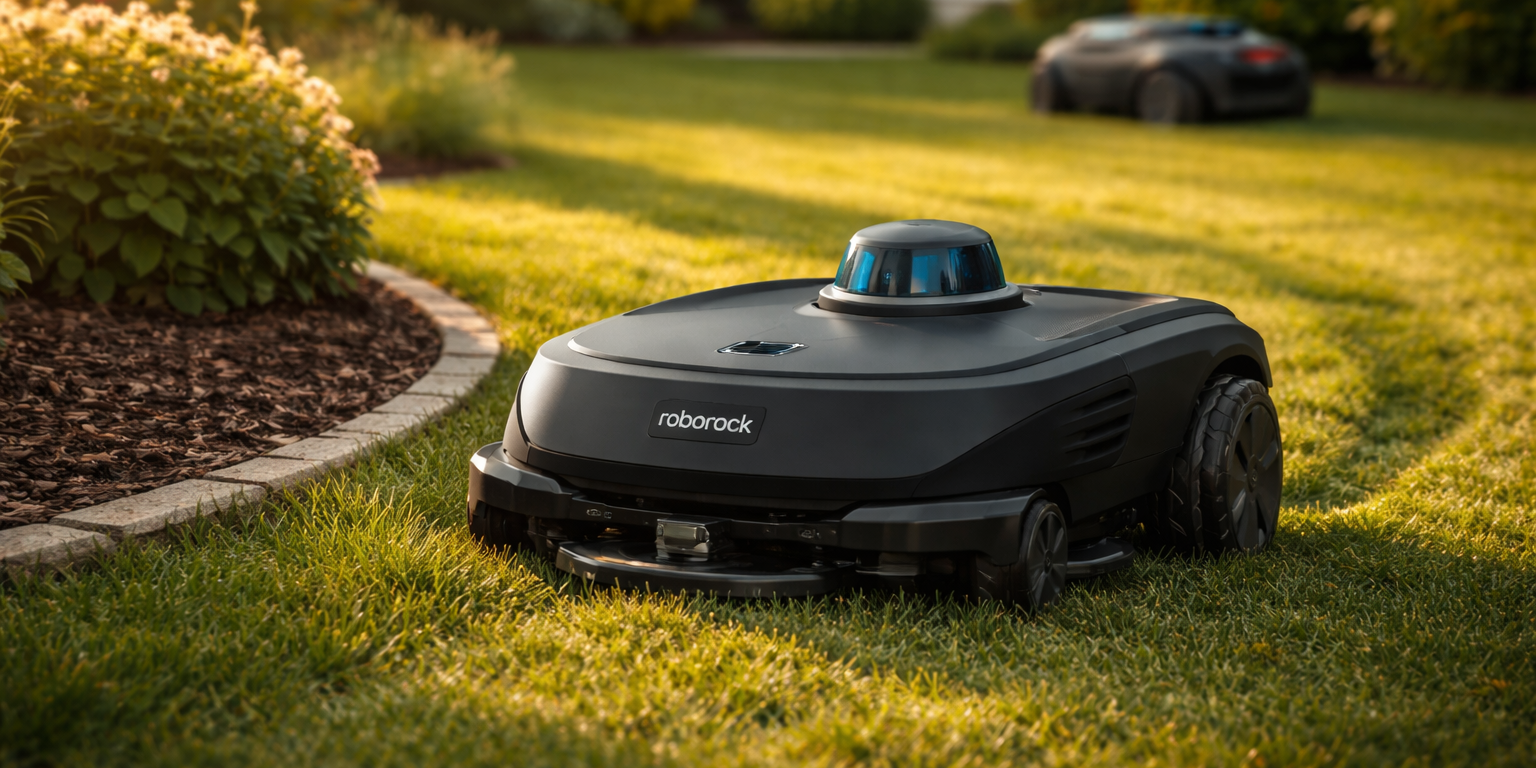
Roborock shipped its first robot lawn mower in North America during the second quarter of 2026, pricing the RockNeo Q110H at $1,199 and betting that the same LIDAR-based navigation that made its vacuum cleaners competitive against iRobot could disrupt a lawn care market still dominated by perimeter wire installations. The machine cuts a 220mm swath and navigates without boundary cables, relying instead on real-time terrain mapping adapted from the company's S-series vacuum platform. Testing by Gizmodo confirmed the mower operates at 58 decibels during daytime runs, roughly equivalent to ambient conversation volume and quieter than the 70-plus decibel output typical of wire-guided competitors from Husqvarna and Worx.
The timing reflects broader consolidation in domestic robotics. Roborock recorded $1.8 billion in revenue for fiscal 2025, almost entirely from vacuum cleaners sold through Amazon and direct channels. Management disclosed during an April 2026 earnings call that lawn care represented a logical adjacency, given the company already manufactures brushless DC motors, lithium battery packs, and embedded vision systems at scale in Changzhou. The Q110H shares a common processor architecture with the Qrevo Slim released six months earlier, enabling the company to amortize software development costs across product lines. Unlike vacuums, however, the mower must handle variable grass height, wet conditions, and obstacles like sprinkler heads challenges that required the engineering team to retrain its obstacle avoidance neural network on a new dataset collected across residential properties in Shenzhen and suburban Phoenix.
Field performance data matters more than feature lists in this category. The Q110H maps up to 2,000 square meters of lawn area and stores boundary definitions in onboard flash memory, eliminating the installation labor that adds $200 to $400 to the effective cost of wire-based systems. Roborock implemented a dual-blade cutting mechanism spinning at 3,600 RPM, mulching clippings into sub-10mm fragments that decompose in place rather than requiring bagging. The unit runs for 180 minutes per charge cycle, sufficient to cover roughly 400 square meters before returning to its base station for automated recharging. GPS augments LIDAR positioning when the satellite constellation provides adequate coverage, though the system defaults to pure visual odometry in tree-shaded yards where multipath interference degrades location accuracy. Gizmodo's testing noted the mower occasionally required manual repositioning after encountering slopes steeper than 24 degrees, a limitation Roborock attributes to traction control algorithms tuned conservatively to prevent rollover risk.
The product's arrival complicates strategic calculations for established mower brands. Husqvarna's Automower division generated approximately $430 million in 2025 sales, maintaining dominant share in Europe where robotic mowers account for 18 percent of all lawn care equipment purchases. North American adoption lags at roughly four percent penetration, held back by installation complexity and unit prices between $1,500 and $3,500 for models covering typical suburban lots. Roborock's wire-free approach directly targets that friction point. If the company replicates even a fraction of the vacuum market trajectory where it grew from zero to 11 percent U.S. market share in four years traditional mower OEMs face margin pressure. Deere & Company and Toro have both prototyped autonomous mowers but have not committed to consumer launches, apparently wary of cannibalizing profitable ride-on equipment sales. Meanwhile, Mammotion and Segway released wire-free mowers in Asia during 2025, signaling that Chinese manufacturers view lawn care as the next horizontal expansion after vacuuming and window cleaning.
What to Watch: Roborock's U.S. distribution partnership with Home Depot, expected to formalize before the spring 2027 selling season, will determine whether the Q110H gains floor space alongside traditional push mowers or remains confined to online channels. Husqvarna's response to wire-free competition likely arrives at CES 2027, where the Swedish manufacturer historically previews annual product updates. Track Amazon review velocity through October 2026 early adopter feedback typically predicts whether mass-market consumers will tolerate the setup complexity inherent in any first-generation boundary-mapping system.