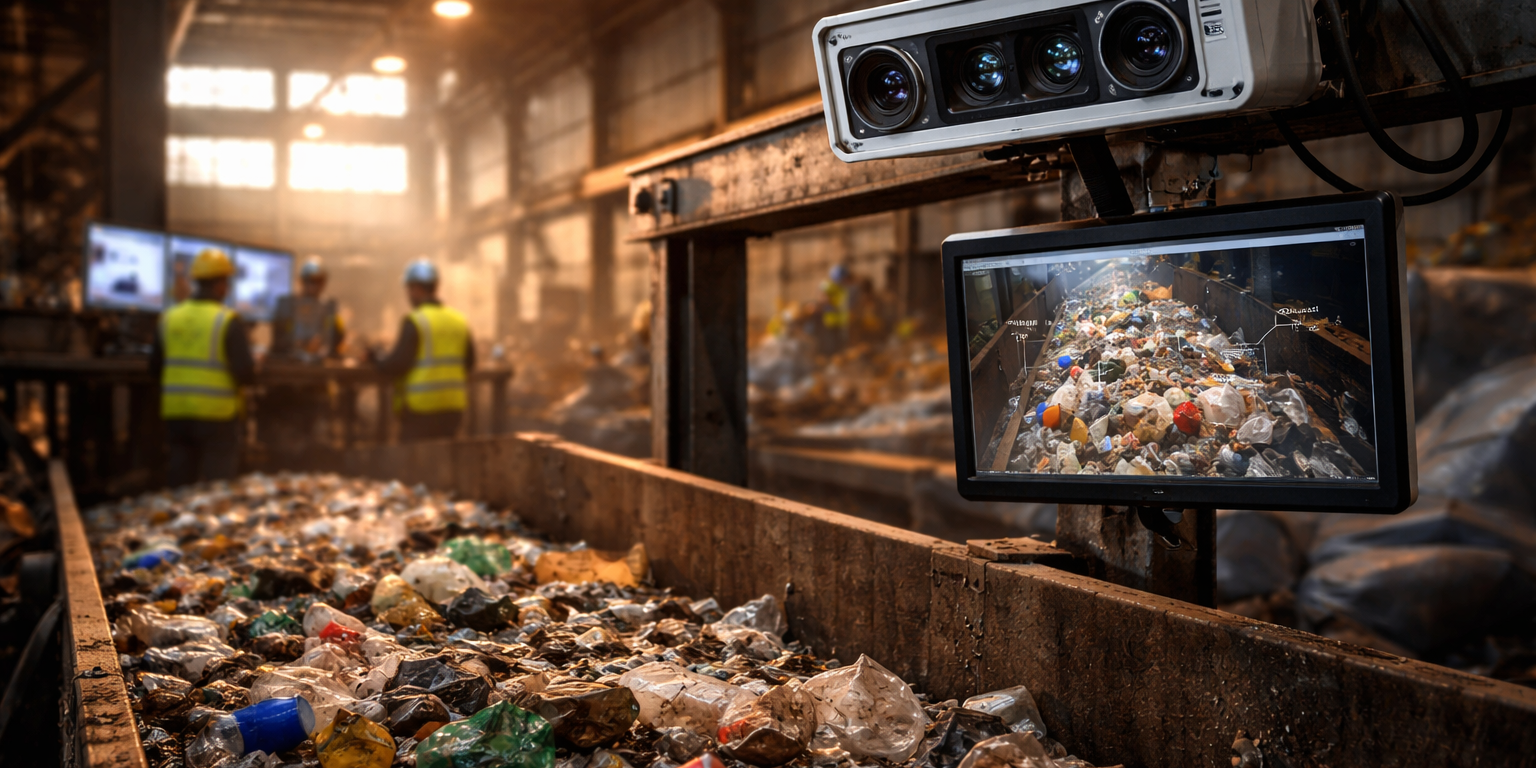
Jaipur Robotics secured $4.3 million in seed funding to scale computer vision systems designed for waste-to-energy plants, where automated material sorting remains one of the last analog holdouts in industrial processing. EquityPitcher Ventures and High-Tech Gründerfonds led the round for the Swiss company, which has spent three years building vision algorithms capable of identifying contaminated feedstock on conveyor belts moving at industrial speeds. Most waste processing facilities still rely on human sorters to catch non-combustible materials before they reach furnaces, a labor model that struggles with throughput demands and worker safety concerns as feedstock volumes climb.
The company emerged from research at ETH Zurich focused on real-time object classification in chaotic environments, specifically the uncontrolled lighting and material variability found in waste handling operations. Co-founders who declined to be named in early press materials initially targeted recycling plants but shifted to waste-to-energy after discovering that combustion facilities face steeper penalties for contamination events. A single metal object reaching a furnace can trigger shutdowns costing operators upward of $50,000 per incident in lost generation capacity and equipment inspections. Jaipur's system uses hyperspectral imaging paired with edge inference hardware to flag contaminants within 200 milliseconds, fast enough for robotic arms or air jets to divert flagged items before they proceed downstream. The technology handles belt speeds up to two meters per second, matching throughput rates in mid-sized European facilities.
EquityPitcher Ventures, a Zurich-based firm with prior investments in industrial automation, cited material recovery rates as the primary draw. Managing partner Stefan Meier noted that waste-to-energy plants across Germany and Switzerland face tightening fuel quality standards as grid operators demand more predictable heat output from combined heat and power configurations. Plants that cannot guarantee consistent calorific values risk losing long-term contracts with district heating networks, creating immediate demand for real-time feedstock monitoring. High-Tech Gründerfonds, Germany's largest seed investor for technical startups, participated after Jaipur demonstrated a pilot system at a 120,000-ton-per-year plant in Bavaria that reduced contamination incidents by 68 percent over a six-month trial. The system identified PVC components, which release corrosive gases during combustion, with 94 percent accuracy across mixed municipal waste streams.
The funding arrives as waste-to-energy operators confront capacity constraints that manual sorting cannot address. The European waste-to-energy sector processed 96 million tons of municipal solid waste in 2025, up 11 percent from 2022, according to the Confederation of European Waste-to-Energy Plants. Facilities built in the 1990s were not designed for current throughput demands or the material complexity introduced by single-stream collection systems, which mix paper, plastics, glass, and organics without pre-sorting. Jaipur plans to deploy systems in eight additional plants by mid-2027, targeting facilities in Switzerland, Austria, and northern Italy where regulatory pressure on emissions and ash toxicity has intensified. The company is also developing modules for cement kilns, which increasingly co-fire refuse-derived fuel alongside coal and petroleum coke. Cement producers need vision systems capable of rejecting chlorine-heavy materials that damage kiln linings, a specification Jaipur's hardware roadmap addresses with upgraded sensor arrays scheduled for late 2026 testing.
What to Watch: Jaipur Robotics will install its first post-funding system at a facility in Zurich before the end of 2026, serving as a reference site for Swiss waste management companies evaluating automation upgrades. EquityPitcher Ventures has signaled interest in follow-on funding tied to deployment milestones, with a Series A potentially materializing in early 2027 if the company hits ten contracted sites. Competing approaches from established vision hardware vendors like Sick AG and Cognex may enter waste processing as the sector demonstrates willingness to invest in automated sorting, particularly if Jaipur's installations show rapid payback periods below 18 months.