
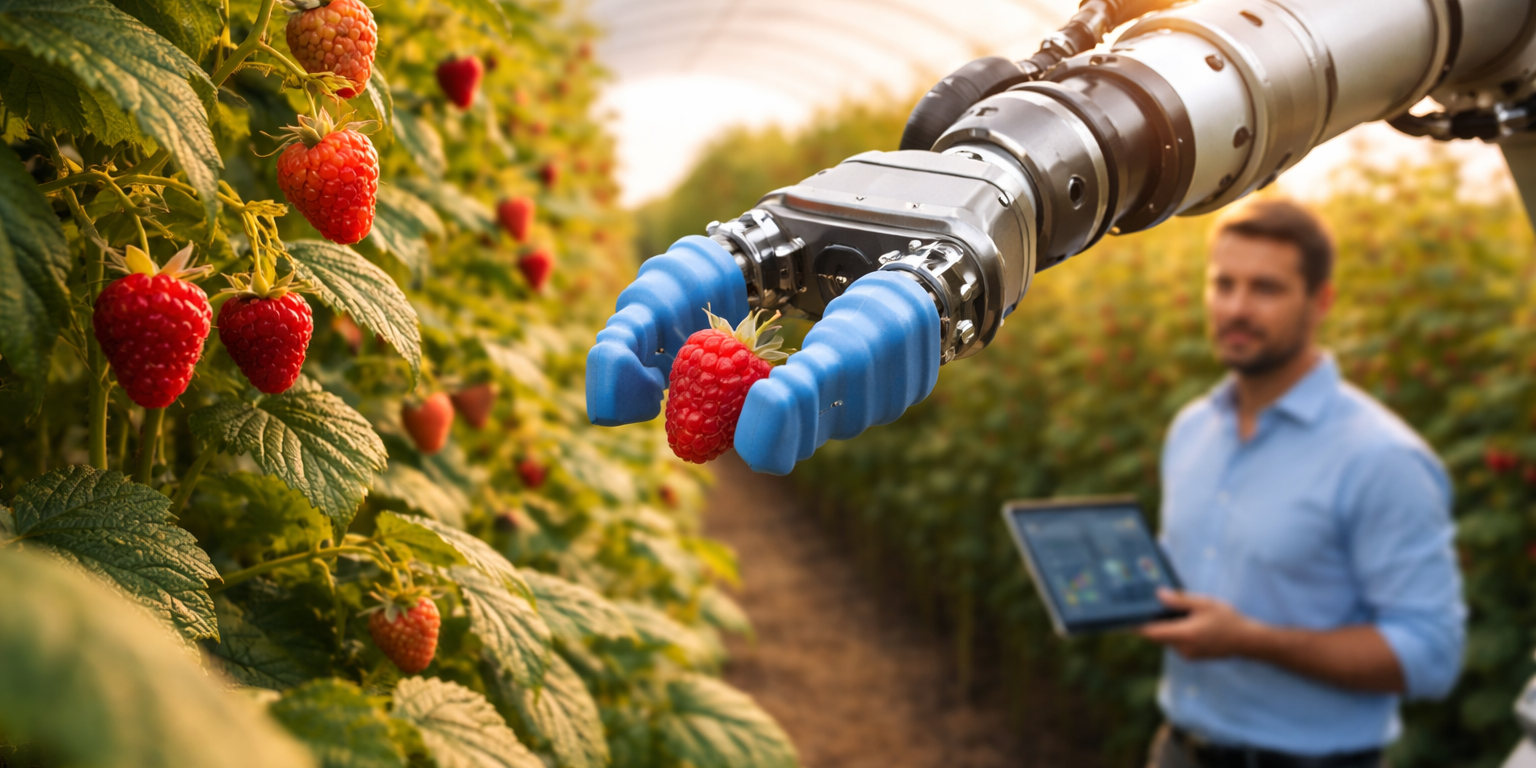
Jim Mellon's SEED Innovations has doubled down on Fieldwork Robotics with a follow-on investment sized to push the Cambridge startup's raspberry harvesting robot into commercial production across UK farms by late 2026. The capital injection arrives as British soft fruit growers enter their third consecutive season of acute labor shortages, with industry estimates pegging unharvested raspberry crops at £45 million annually due to missing pickers during the compressed June-through-August harvest window. Fieldwork declined to disclose the precise funding amount but confirmed the round brings total capital raised to date above £8 million, including previous backing from the same investor and Innovate UK grants. The company has been piloting its raspberry picker on commercial farms since 2024, accumulating field data that now informs the production-ready design shipping to growers in the coming months.
Fieldwork's system differs from earlier attempts at soft fruit automation by targeting raspberries first rather than strawberries, a counterintuitive choice given that strawberries represent the larger market. Raspberries grow on tall canes in linear rows and present a more structured picking environment than ground-level strawberry beds, but the fruit itself is more delicate and bruises easily under mechanical pressure. The robot uses a combination of stereo cameras and machine learning models trained on thousands of raspberry images to identify ripe fruit, then deploys soft grippers designed to handle the fragile berries without damage. Each unit operates autonomously between rows, making picking decisions in real time and depositing fruit into onboard containers that human workers periodically swap out. The company reports pick rates of 25-30 seconds per punnet equivalent during field trials, slower than an experienced human picker but fast enough to justify deployment when human labor is unavailable or prohibitively expensive. Fieldwork has tested the system across multiple growing seasons at partner farms in Scotland and southeast England, refining both hardware durability and the computer vision stack to handle variable lighting and foliage density.
SEED Innovations entered Fieldwork's cap table in early 2024 as part of a broader portfolio strategy targeting agricultural robotics and alternative protein ventures. Mellon, who made his initial fortune in fund management before pivoting to life sciences and agtech investing, has publicly positioned agricultural automation as a hedge against demographic shifts reducing farm labor availability across developed economies. The UK soft fruit sector employs roughly 30,000 seasonal workers annually, with approximately 90% arriving from Eastern Europe under temporary visa schemes. Post-Brexit immigration policy tightening and competing wage opportunities in other EU nations have compressed the available labor pool, pushing some growers to leave fruit unpicked or reduce planted acreage. Fieldwork's robot enters a market where the alternative to automation is not cheaper human labor but crop loss or farm consolidation. The economics hinge on utilization rates during the short harvest season and whether a single robot can service enough plants to offset its capital cost, which the company has not yet disclosed but industry observers estimate in the £80,000-£120,000 range based on comparable agricultural robots.
The commercial timing aligns with a broader wave of soft fruit automation reaching deployment stage after years of development. Dogtooth Technologies, another UK-based startup, has been piloting strawberry pickers in commercial greenhouses and recently announced expanded trials in Spain and Portugal. Advanced Farm Technologies in California has deployed its precision strawberry harvester across several hundred acres domestically. Fieldwork's raspberry focus gives it a narrower but less crowded market segment, with the global raspberry market valued near £2 billion annually and concentrated in regions with high labor costs, Poland, Serbia, the United States, and the UK among them. The key technical hurdle remaining involves throughput scaling, whether a farm can justify deploying multiple units to cover its acreage or if single-robot deployments pencil out only for smaller operations. Fieldwork has not disclosed how many units it plans to manufacture in the initial production run or whether it will sell or lease the systems to growers. The business model choice will determine how quickly the technology spreads, outright purchase requires larger upfront capital but appeals to established farms, while leasing lowers barriers for smaller growers testing automation for the first time.
What to Watch: Fieldwork Robotics has indicated initial commercial units will reach UK farms by Q4 2026, watch for customer announcements and deployment numbers as harvest season approaches. SEED Innovations portfolio company Agronomics, which focuses on cultivated meat and precision fermentation, may signal whether Mellon's agtech strategy expands further into field robotics or remains anchored in indoor agriculture. UK growers association British Summer Fruits publishes annual labor availability data each autumn, the 2026 figures will indicate whether robotics adoption is offsetting workforce shortages or if crop losses persist despite automation investments.